Loading...


MedPhy-Quiz 1 PART 1
Quiz by Noime S. Diwa
Tag the questions with any skills you have. Your dashboard will track each student's mastery of each skill.
It is said that in 250 BCE, Archimedes was able to set a Roman fleet on fire using a mirror. What kind of mirror was this?
A person is 1.4 m tall. What minimum size of a plane mirror does he or she needs to see hit or her full reflection?
Which mirror can produce an upright image that is smaller than the object?
A ray of light is incident at 45°. What is its angle of reflection?
You stand 1.0 m in front of a plane mirror. How far is your image from you?
Which is NOT a characteristic of images formed in plane mirrors?
A concave mirror has a radius of curvature of 12 cm. What is its focal length?
Which part of a spherical mirror is situated midway between the center of curvature and the vertex?
When an object is placed at the center of curvature of a concave mirror, the image is ________.
As used in the law of reflection, the word normal means ________.
A card in front of a plane mirror reads "LUCKY". Which of the following is TRUE?
Which mirror always produces a magnification equal to 1?
The focal length of a spherical mirror is how many times its radius of curvature?
Which ray striking a spherical mirror will be reflected along itself?
Which type of mirror always produces a virtual image that is smaller than the object?
Which of the following statements best describes a lens ray diagram?
In a lens ray diagram, where is the object located?
What happens to light rays when they pass through a diverging lens?
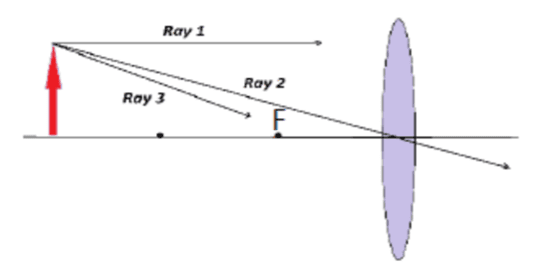
In the figure, which ray(s) will pass through the primary focus after refraction?I
Where will the image form if the object is placed between F and 2F as shown in the figure?
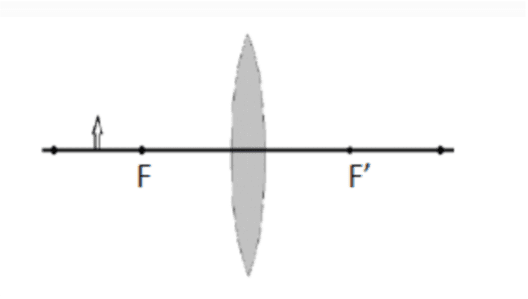
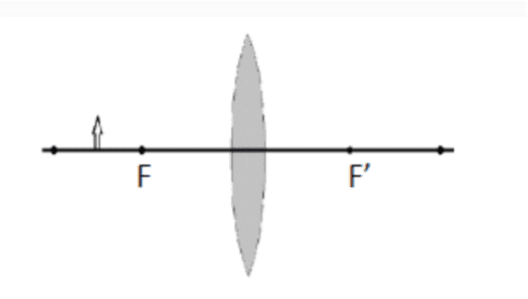
What type of image will be formed in the lens?
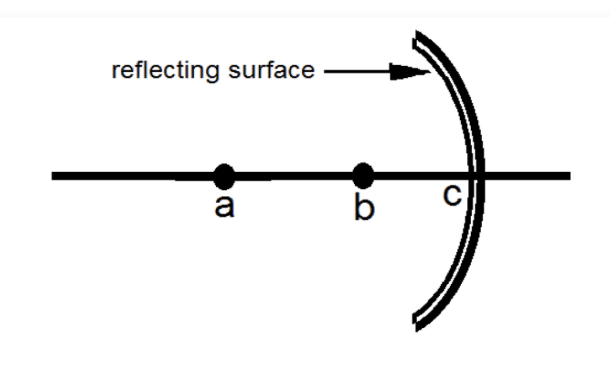
Which term refers to the length between b and c in the given figure?
Which of the following supports the laws of reflection?
I. The angle of incidence is equal to the angle of reflection.
II. The angle of incidence is greater than or less than the angle of reflection depending on the medium.
III. The incident ray, the normal line, and the reflected ray lie on the same plane.
IV. The incident ray, the normal line and the reflected ray lie on different planes.
Which is true about the image formed in the plane mirror?
I. Real
II. Virtual
III. Upright
IV. Inverted
V. Same size
VI. Magnified
VII. Diminished
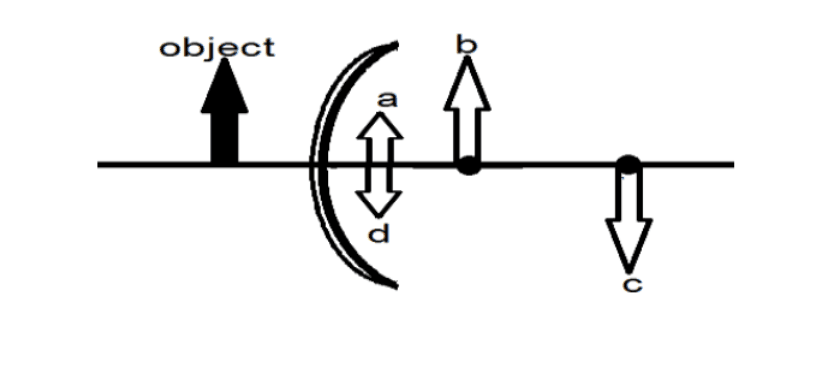
In what position will the image be if an object is placed in front of a convex mirror as shown in the figure?
An instrument that uses a set of lenses to magnify small objects.
What is the refractive index of a lens?
What happens to the direction of light when it passes from air to water?
What happens to the direction of light when it passes from air to water?