
Post Test: Science G10 3Q Module 6
Quiz by Jerald U. Carilla
Feel free to use or edit a copy
includes Teacher and Student dashboards
Measure skillsfrom any curriculum
Tag the questions with any skills you have. Your dashboard will track each student's mastery of each skill.
- edit the questions
- save a copy for later
- start a class game
- automatically assign follow-up activities based on students’ scores
- assign as homework
- share a link with colleagues
- print as a bubble sheet
- Q1
1. The most important finding from the fossil record which supports the theory of evolution is ______.
That ancient species differed from those alive today.
That life has evolved.
That life evolved in the ocean.
That most species are extinct.
30s - Q2
2. Bird wings and insect wings are considered to be ______.
Homogenous structures.
Vestigial structures.
Homologous structures.
Analogous structures.
30s - Q3
3. The wing of the bat and the forelimb of the dog are said to be homologous structures. This indicates that ___.
The limb bones of each are anatomically identical
They are structures that are similar due to common ancestry
They have the same function
Bats evolved from a lineage of dogs
30s - Q4
4. Some organisms that share a common ancestor have features that have different functions, but similar structures. These are known as ______.
Vestigial structures
Homologous structures
Fossil structures
Analogous structures
30s - Q5
5. Scientists think that dolphins and whales may have evolved from a common ancestor. What evidence supports this hypothesis?
They swim the same way.
They live in the same area of the ocean.
They eat the same food.
They have similar anatomies.
30s - Q6
6. If a scientist were to find 4 fossils that appear to be of the same ancestor, what can be concluded?
Fossils were found in the same rock layer.
Members of the group living today live together.
Number of each fossil is similar.
Fossils have similar characteristics.
30s - Q7
7. The diagram shows fossils in different rock layers. Which of these statements about the age of these fossils are most likely correct?
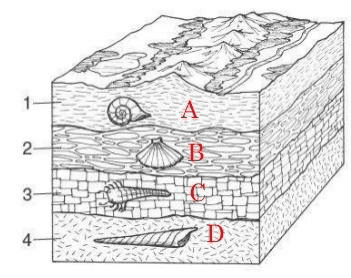
Fossil B is older than fossil C
Fossils A is older than fossil B
Fossil A and C are the same age
Fossil D is older than fossil C
30s - Q8
8. Based on Table 6, which of the primates is most distantly related to a human?
Chimpanzee
Rhesus monkey
Spider monkey
Tarsier
30s - Q9
9. Based on Table 6, which of the primates has the most recent common ancestor to humans?
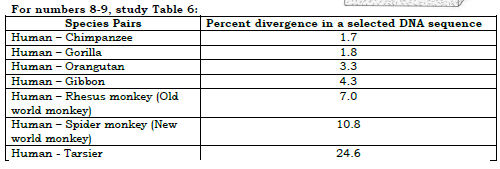
Tarsier
Orangutan
Gorilla
Chimpanzee
30s - Q10
10. The diagram illustrates the embryonic stage of two organisms. Which of the following can be determined by observing the embryos shown in the diagram?
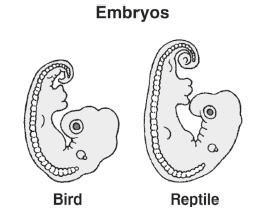
The organisms share a common ancestry.
The organisms will grow into anatomically similar Adults.
The organisms are native to the same geographic areas.
The organisms belong to the same genus.
30s