Apply place-value strategies to solve problems.
Round two- and three-digit whole numbers to the nearest ten or hundred, respectively.
Solve two-step word problems using the four operations (expressions are not explicitly stated). Limit to problems with whole numbers and having whole-number answers.
Multiply one-digit whole numbers by two-digit multiples of 10 (from 10 through 90).
Compare two fractions with the same denominator (limit denominators to 1, 2, 3, 4, 6, and 8), using the symbols >, =, or <, and/or justify the conclusions.
Interpret and/or describe products of whole numbers (up to and including 10 × 10). Example 1: Interpret 35 as the total number of objects in 5 groups, each containing 7 objects. Example 2: Describe a context in which a total number of objects can be expressed as 5 × 7.
Determine the unknown whole number in a multiplication (up to and including 10 × 10) or division (limit dividends through 50 and limit divisors and quotients through 10) equation relating three whole numbers. Example: Determine the unknown number that makes an equation true.
Interpret and/or model division as a multiplication equation with an unknown factor. Example: Find 32 ÷ 8 by solving 8 × ? = 32.
Use operations, patterns, and estimation strategies to solve problems (may include word problems).
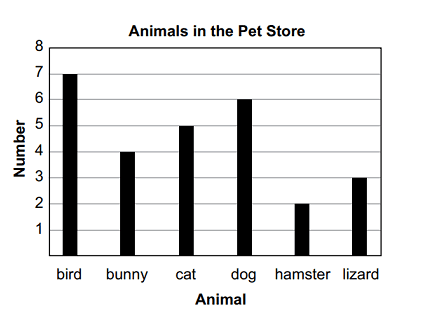
Solve one- and two-step problems using information to interpret data presented in scaled pictographs and scaled bar graphs (scales limited to 1, 2, 5, and 10). Example 1: (One-step) “Which category is the largest?” Example 2: (Two-step) “How many more are in category A than in category B?”
Create or match a story to a given combination of symbols (+, –, ×, ÷, <, >, and =) and numbers.
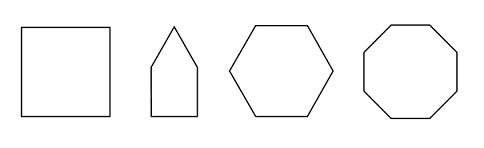
Analyze characteristics of polygons.
Recognize rhombi, rectangles, and squares as examples of quadrilaterals and/or draw examples of quadrilaterals that do not belong to any of these subcategories.
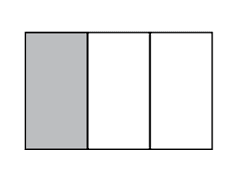
Partition shapes into parts with equal areas. Express the area of each part as a unit fraction of the whole. Example 1: Partition a shape into 4 parts with equal areas. Example 2: Describe the area of each of 8 equal parts as 1/8 of the area of the shape.
Calculate elapsed time to the minute in a given situation (total elapsed time limited to 60 minutes or less).
Find and use the perimeters of plane figures.
Track each student's skills and progress in your Mastery dashboards