Loading...


Python Problem Solving Code
Quiz by Ainin Sofiya Hisham
Tag the questions with any skills you have. Your dashboard will track each student's mastery of each skill.
Which element is used to plan logic before coding?
Blockly is mainly used to help learners understand:
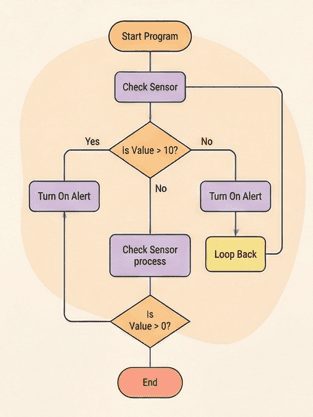
In the flowchart, what happens when the sensor value is greater than 10?
Which Python collection is unchangeable?
What is the purpose of using IF conditions in programming?
import random
guess = None
computerpicked_number = None
guess = 1 #assign 1 to guess variable to start the game
print("Welcome to the guessing game!")
print("I have picked a number between 1 and 10. Can you guess it?")
computerpicked_number = random.randint(1, 10)
while guess != computerpicked_number:
guess = int(input("Enter your guess: "))
if guess < computerpicked_number: number
print("Too low! Try again.")
elif guess > computerpicked_number:
print("Too high! Try again.")
print("Congratulations! You guessed the number! Wohoo!")
What does random.randint(1, 10) do in this program?
How does the elif statement function in this number‑guessing program?
Below is code snippet about quiz on Python.
Fill in the correct answer to complete the code.
Your answer format should be xxxx, yyyy, zzzz
print('Welcome to AskPython Quiz')
answer=_________ ('Are you ready to play the Quiz ? (yes/no) :')
score=0
total_questions=1
if answer.lower()=='yes':
answer=input('Question 1: What is your Favourite programming language?')
if answer.lower()=='python':
_________ += 1
print('correct')
_______ :
print('Wrong Answer :(')
In Python, elif and else are used to handle multiple conditions within a single decision-making structure. They ensure that your program follows exactly one path out of several possible options.
Use _______ as a "catch-all" or default action.