QB1 Remediation
Quiz by Emily Grady
Feel free to use or edit a copy
includes Teacher and Student dashboards
Measure skillsfrom any curriculum
Measure skills
from any curriculum
Tag the questions with any skills you have. Your dashboard will track each student's mastery of each skill.
With a free account, teachers can
- edit the questions
- save a copy for later
- start a class game
- automatically assign follow-up activities based on students’ scores
- assign as homework
- share a link with colleagues
- print as a bubble sheet
24 questions
Show answers
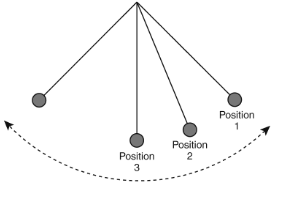
- Q1When a pendulum is released, it swings back and forth. It will continue moving without any additional push until it is slowed by friction from the air around it. This illustration demonstrates three positions of a pendulum during its swing. At which point does the pendulum weight have the greatest amount of potential energy?Gravitational potential energy does not change.Position 1Position 2Position 3120s
- Q2What is the Law of Conservation of Energy?Heating an object creates energy and cooling destroys energy .The total amount of energy on Earth is constant and is conserved over time.Energy can be created or destroyed, but never transformed.Energy can only be created when a force acts on an object.120s
- Q3A delivery driver recorded the distance her van traveled each hour of her workday. Which statement describes the van’s motion during the time between 4 and 5 h?It was slowing downIts speed was increasing.It was not movingIts speed was constant120s
- Q4Which of the following forces can act only when two objects are in contact with each other?FrictionGravitationalElectricalMagnetic120s
- Q5Some forces act at a distance. Other forces act only when two objects are in contact with each other. Which of the following forces can act across a distance?DragMechanicalFrictionMagnetic120s
- Q6Which properties determine the force of gravity between two objects?Mass and volumeVolume and distanceVolume and densityMass and distance120s
- Q7Two balls are falling from the same ledge. One ball falls straight down. The other ball is moving horizontally when it leaves the ledge. Which of the following statements describes the amount of time needed for the balls to reach the ground?The balls hit the ground at the same time because gravity is the only unbalanced force acting on them.The ball with more mass will hit the ground first because it experiences more acceleration due to gravity.The ball that is falling straight down from the ledge hits the ground first because it does not travel as far.The ball that is moving horizontally away from the ledge hits the ground first because it experiences acceleration in both directions.120s
- Q8In 1895, German physicist Wilhelm Conrad Roentgen discovered x-rays. The drawing below shows an example of a chest x-ray of an adult human. What was the impact of Roentgen’s discovery on medicine?It led to new ways to treat viral illnesses such as influenza and smallpox.It helped doctors develop new ways to treat infections of the bone.It encourage more people to visit doctors after they became ill.It enabled doctors to make more accurate diagnoses than they could before.120s
- Q9Scientists use spacecraft to study a variety of objects in space. What benefits do unmanned spacecraft provide to space scientists?Instruments never commit errorsInstruments can replace analysis by human scientists.Instruments can be sent places humans cannot go.Instruments require more control over the environment than human spaceflight does120s
- Q10Identifying the independent and dependent variables in an experiment will help you better interpret and convey results. What is the difference between the independent and dependent variables in an experiment?The independent variable is always a number, and the dependent variable is never a numberThe dependent variable is what the investigator controls, and the independent variable is what happens as a result of thisThe independent variable is what you control, and the dependent variable is what changes as a result.The dependent variable is typically found in the first column of a table, and the independent variable is typically found in the second column120s
- Q11Scientists conduct many types of scientific investigations. Their efforts often include fieldwork, surveys, models, and experiments. Which statement about scientific investigations is NOT true?They often involve the collection of data under controlled conditionsThey may focus on comparing or describing the unregulated world.They follow exactly the same steps because there is only one scientific methodThey often include multiple trials to increase the consistency of data120s
- Q12Renee rolls a steel ball down a ramp. She conducts multiple trials by releasing the ball from varying heights on the ramp. For each trial, she measures and records the release height of the ball and the distance the ball travels away from the ramp before falling to the ground. The figure below shows the experiment. In this experiment, which variable is the independent variable?Time it takes the ball to hit the ground.Distance traveled by the ballHeight from which the ball is releasedPath of ball once it leaves the ramp120s
- Q13Cindy hypothesizes that plastic foam insulates cold drinks better than metal or ceramic materials do. To test the hypothesis, she fills cups made from these materials with equal amounts of cold water. She records the temperature of the water in each cup, using scientific thermometers, every 10 minutes until the water reaches room temperature. Which of these conditions must be the same for this experiment to be valid?The material of each cupThe ending temperature of the water in each cup.The starting temperature of the water in each cupThe thermometer that is in each cup120s
- Q14Ella paints three identical pieces of metal different colors. She then makes sure they are the same temperature and places them near each other in direct sunlight for 30 minutes. She records temperature data in a table. Based on the procedure and the data, which explanation tells why the temperatures are not the same?Each color absorbs a different amount of heat energyThe mass of each sample varies, which affects heat absorptionThe temperatures of the metal pieces vary at the beginning of the experimentA different amount of sunlight strikes each piece of metal.120s
- Q15Scientific investigations include many different steps. Which step in a scientific investigation can result in the need for a new hypothesis?Identify variablesAnalyze dataFollow a procedurePlan the experiment120s