Loading...


Respiratory System Summative Review Quiz
Quiz by Jenny Ousley
Tag the questions with any skills you have. Your dashboard will track each student's mastery of each skill.
A 56-year-old woman comes to the physician for a scheduled total thyroidectomy because of a large thyroid gland tumor. After she recovered from the anesthesia, she started to experience hoarseness that lasted for 3 weeks. Subsequent examination shows a permanently adducted vocal fold on the right side. Surgical trauma to which of the following muscles is most likely to be responsible for the adducted right vocal fold?
A 32-year-old woman comes to the physician because of weight loss, diarrhea, and heat intolerance. She is diagnosed with hyperthyroidism and is scheduled to have a thyroidectomy. Following surgery, the patient is unable to pass her swallow test. The patient has most likely lost sensation of the larynx from the vocal folds to the entrance into the larynx, causing aspiration of liquids into the airway. Which of the following nerves is most likely injured?
A 45-year-old woman is brought to the emergency department with severe dyspnea for 4 months. The patient has smoked 1 pack of cigarettes a day for 30 years. Radiologic examination confirms the presence of a Pancoast tumor (see image below). Physical examination shows that the patient has miosis of the pupil, partial ptosis of the eyelid, and anhidrosis of the face. Which of the following structures has most likely been injured?

A 29-year-old man is brought to the emergency department after being involved in a motor vehicle collision. He has significant difficulty in breathing. His temperature is 37°C (96.8°F), pulse is 100/min, respirations are 25/min, and blood pressure is 120/90 mm Hg. Physical examination shows no signs of external injuries, but the dyspnea becomes progressively worse. An x-ray of the chest (see image below) shows no fractured bones or mediastinal shift. Which of the following conditions would best describe this case?

A 3-day-old boy is brought to the emergency department for severe dyspnea and cyanosis. Physical examination shows a flat abdomen. An x-ray of the chest shows a left side pneumothorax and pockets of air in the left hemithorax. Which of the following conditions is the most likely diagnosis?
A 32-year-old woman is brought to the emergency department because of a 5-hour history of severe dyspnea and anxiety. For the past 2 months she has been on a liquid diet because of dysphagia and has lost 15 kg (33 lb). Over the past several weeks, she has had bloody sputum during attacks of coughing and hoarseness. Fluoroscopy and a barium swallow show a 4-cm mass in the trachea compressing the thoracic esophagus. Which of the following nerves is most likely to be affected?
A 51-year-old man is brought to the emergency department because of chest pain and severe shortness of breath. His blood pressure is 86/52 mm Hg, and pulse is 115/min. Physical examination shows absent breath sounds on the right side and distended jugular veins. An x- ray of the chest shows a tension pneumothorax. Adequate local anesthesia of the chest wall prior to insertion of a chest tube is necessary for pain control. Which of the following is the deepest layer that must be infiltrated with the local anesthetic to achieve adequate anesthesia?
A 5-year-old boy is brought to the emergency department by his mother for difficulty breathing and coughing which started half an hour ago. The boy was seen earlier playing with his small toy cars. Physical examination shows decreased breath sounds. A foreign body aspiration is suspected. Where in the tracheobronchial tree is the most common site for a foreign object to lodge?
A 58-year-old woman is brought to the emergency department because of severe shortness of breath. Her blood pressure is 120/80 mm Hg, pulse is 76/min, and respirations are 35/min. Bronchoscopy shows that the carina is distorted and widened. Enlargement of which group of lymph nodes is most likely responsible for altering the carina?
A 51-year-old woman is brought to the emergency department because of chest pain. She has a history of brain tumor and severe oropharyngeal dysphagia. She received chemotherapy two days ago and has had intractable episodes of vomiting. Physical examination of the chest shows dullness to percussion over the right lung field. Crackles are heard on auscultation. An x-ray of the chest shows pneumonia of the right lower lobe. Which of the following is the most likely explanation of pneumonia affecting the right lower lung lobe?
A 21-year-old woman is brought to the emergency department with severe dyspnea after a fall from the uneven parallel bars during her gymnastic practice. An x-ray of the chest shows that her right lung is collapsed and the left lung is compressed by the great volume of air in her right pleural cavity. Physical examination does not show any signs of external injuries. Which of the following conditions will most likely describe this case?
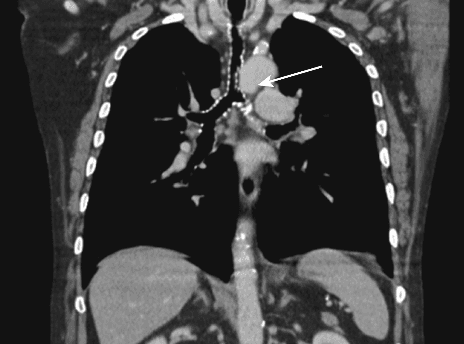
A 42-year-old woman is brought to the emergency department with gradually worsening dysphagia for a month. She also has hoarseness. A CT scan (see image) of the thorax shows a small aortic aneurysm. Which of the following nerves will most likely be compressed if the aortic aneurysm continues to grow?
A 25-year-old woman is brought to the emergency department with dyspnea and unintentional weight loss for 6 months. She smoked 2 packs of cigarettes a day for 10 years. Vitals are within normal limits. An x-ray of the chest shows a tumor invading the lung surface just anterior to the hilum. Which nerve is being compressed by the tumor?
A 25-year-old woman was brought to the emergency department after suffering a gunshot wound to the back. Her temperature is 38.9°C (102°F), pulse is 110/min, respirations are 24/min, and blood pressure is 90/70 mm Hg. The left thorax was notably larger than the right with decreased breath sounds on auscultation and hyperresonance to percussion of the left chest. A tracheal tug to the right side was noted. She was assessed as having a tension pneumothorax and the physician prepared to perform an emergency decompression of the left thorax. Between which layers will the needle have to be placed to relieve the pneumothorax?
A 30-year-old man is brought to the emergency department because he was stabbed in his right anterior chest wall with a sharp instrument in a domestic dispute. Physical examination shows a puncture wound in the third right intercostal space at the midclavicular line and distended neck veins. There is hyperresonance on percussion and absent breath sounds on the right hemithorax. An x-ray of the chest shows a deviated trachea to the left and bilateral opacities which are consistent with acute respiratory distress. Which of the following is the most likely diagnosis?
A 35-year-old man is brought to the emergency department after being involved in a hit and run motor vehicle collision. Physical examination shows multiple skin lacerations but not any major bleeding. An x-ray of the chest shows broken ribs 5–7, but no evidence of punctured pleura. The lung field appears opacified. Several hours later the patient appears cyanotic. What is the most likely cause of the cyanosis?
A 27-year-old man is brought to the emergency department after being stabbed in the chest during a bar fight. He has a severe chest pain upon breathing. His temperature is 38.9°C (102°F), a pulse is 110/min, respirations are 25/min, and blood pressure is 80/50 mm Hg. Physical examination shows a jugular vein distention right-sided hyperresonance on percussion, and decreased breath sounds over the right lung. An x-ray of the chest shows decreased vascular markings on the right side and a tracheal deviation to the left. Which of the following is the most likely diagnosis?
A 35 y/o man is brought to the ER by ambulance after a skiing accident where he was intubated in the field. His chest x-ray is pictured below. Which of the following explains these findings?
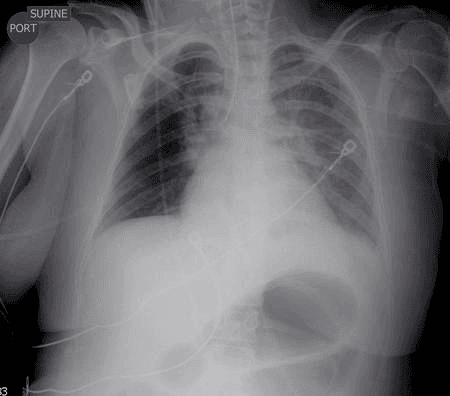
A 55 y/o patient presents to the emergency room with new onset facial plethora and swelling in the supraclavicular fossa. He also complains of numbness and tingling in his right hand. On physical exam, his right pupil is constricted and there is drooping of his right eyelid. Based on the imaging below, which of the following is the most likely diagnosis?

A 57 y/o man presents complaining of the progressive onset of hoarseness. He denies any coughing, rhinorrhea or postnasal drip. He has a 15 pack year smoking history and works as an accountant. A physical exam reveals ptosis, miosis and anhidrosis of the right side of his face. He also has tenderness to passive movement of his right shoulder. Which of the following chest x-rays is indicative of the most likely diagnosis?