Loading...


Simply KRBest Coaching 44
Quiz by KENNETH REGENE BLASCO
Tag the questions with any skills you have. Your dashboard will track each student's mastery of each skill.
A newly appointed school head observesthat one of the newly hired teachers is struggling to adapt to DepEd systems,policies, and professional culture. The teacher frequently asks questions aboutworkflow, reporting protocols, and expectations, but classroom instructionremains satisfactory. The teacher expresses anxiety about fitting into theorganizational environment rather than instructional competence.
As a school leader committed toprofessional development aligned with PPSSH, which intervention should theschool head prioritize to address this concern while maintaining professionalstandards and accountability?
A school principal is known for living within modest means despite occupying a high-ranking administrative position. He consistently refuses unnecessary privileges and avoids public displays that may be perceived as excessive. Teachers and community members frequently cite him as a model of integrity and ethical leadership.
Which standard of professional conduct is most accurately demonstrated by the principal’s behavior, considering ethical norms governing public officials in the education sector?
A Master Teacher recently promoted seeks clarity on his expected level of practice under the PPST. He actively mentors colleagues, reflects on instructional effectiveness, and collaborates to improve school-wide teaching outcomes. However, he does not yet demonstrate nationwide influence or system-level impact.
Which combination of professional practices best defines his current career stage as stipulated in DepEd standards?
During the monitoring phase of RPMS, a school head documents both positive and negative performance incidents using the PMCF. He also provides advice and encouragement to the teacher to address observed gaps and improve outcomes.
Which activity in this scenario does NOT belong strictly to the performance monitoring phase under RPMS guidelines?
Two newly hired teachers with less than three years of teaching experience are formally integrated into school operations. The school head is designing support mechanisms aligned with national induction policies to ensure competency development and retention.
Besides serving as mentor, which responsibility must the school head primarily fulfill under the Teacher Induction Program?
In evaluating the effectiveness of a Learning Action Cell, school leaders examine its contribution to school improvement. Data reveal collaborative lesson planning, improved instructional strategies, and positive learneroutcomes.
Which focus best aligns with DepEdexpectations when assessing LAC effectiveness?
A Teacher I hired on June 5 is inquiring about entitlement to theyear-end bonus. The teacher rendered service continuously until October 31 ofthe same year, earning a monthly salary within the standard Teacher I range.
How should the school head correctlydetermine the teacher’s entitlement according to DBM and DepEd rules?
A retiring teacher with over thirty-five years of service has demonstrated loyalty, competence, and professionalism. The school head wishes to formally recognize the teacher’s contribution consistent with DepEd PRAISE guidelines.
Which action is most appropriate for institutional recognition of long-term service?
A school head is placed under preventive suspension while facing administrative charges involving dishonesty. The disciplinary authority explains the rationale behind the temporary removal from office.
Which justification correctly supports the issuance of preventive suspension?
A Teacher-in-Charge (TIC) is designated to manage a school with sufficient teaching personnel. Teachers inquire whether the TIC should still carry teaching loads despite administrative designation.
What is the correct interpretation ofthe TIC’s teaching obligation?
Principal Aranas observed that while the school's mission is displayed prominently in every hallway, the teachers still prioritize individual classroom goals over the shared institutional targets. During a series of classroom observations, he noticed that many teachers treat the Vision, Mission, and Core Values as mere static text for display rather than as a functional guide for daily operations. He realized that the lack of a shared understanding was hindering the school's ability toachieve its long-term strategic objectives for learner development.
To address this, he wants to move beyond simple awareness and ensure that every school project, policy, and activity is a direct expression of the Department’s foundational principles. He plans to reorganize the school’splanning committee to specifically review all upcoming projects through the lens of the DepEd VMV. He believes that by aligning administrative decisions with these core values, the school can foster a more cohesive and purpose-driven environment for both the faculty and the students.
Based on the scenario, which action demonstrates that the school head has successfully institutionalized the DepEd VMV?
During the final review of the School Improvement Plan (SIP), the leadership team discovered that many of the achievement targets were based on general assumptions rather than actual classroom data. The school head observed that current science laboratory facilities were under utilized while teachers lacked training in modern inquiry-based learning techniques. He concluded that a strategic plan without a solid evidence base would likely fail to meet the actual needs of the diverse learners and would lead to a waste of limited resources.
To rectify this, the principal decided to conduct a thorough "Gap Analysis" involving the subject coordinators and the school planning team. They analyzed the results of the recent quarterly assessments and the National Achievement Test (NAT) to pinpoint the specific competencies where students were struggling. He intends to use this data to redesign the school’s professional development plan and allocate the Maintenance and Other Operating Expenses (MOOE) funds toward targeted instructional interventions that address the identified performance gaps.
Which strategic action should the principal take to ensure the plan accurately addresses this identified performance gap?
A new national directive on "Inclusive Education" was recently issued to all schools, but many teachers in the senior high school department expressed concern that they are not prepared to handle students with disabilities. Principal Santos knows that simply forwarding the memo through the school’s group chat is insufficient for meaningful change. He observed that without a clear implementation and review mechanism, the policy would remain a theoretical document rather than a practical guide for classroom inclusivity.
To ensure the policy results in meaningful changes, he organized a series of consultative meetings to identify the specific barriers to inclusion within the school’s current setup. He established a "Policy Review Committee" to monitor how the new inclusive standards are being integrated into the individual lesson plans and the school’s physical facilities. His goal is to create a feedback loop where teachers can report challenges and the school administration can provide the necessary resources and adjustments to support the policy’s success.
Which approach demonstrates the most effective implementation and review of this new national educational policy?
Principal Rivera observed a recurring issue where students in the senior high school were consistently struggling with research-based subjects and data analysis. He noticed that the current interventions, such as after-school remedial sessions, were based on anecdotal evidence from a few teachers rather than a systematic investigation. He realized that the school lacked a culture of inquiry where problems are diagnosed through research and solutions are tested through innovative instructional practices.
To find a sustainable solution, he encouraged the faculty to engage in Action Research to determine the root causes of the students’ difficulties. Heprovided them with time during LAC sessions to collaborate on research designs and pledged to use the findings to inform the school’s next procurement of library and laboratory resources. He believes that by institutionalizing research, the school can move away from "trial and error" interventions and toward evidence-based innovations that truly improve student learning.
How does the principal best promote a culture of research and innovationwithin the school organization?
Explanation:
The school is planning a new feeding program for malnourished students, but the principal wants to ensure that the program is not just a temporary donation-based fix. He observed that previous health initiatives failed because they were not properly integrated into the school’s annual implementation plan and lacked a monitoring system to track student progress. He wants to design a program that involves parents, local health workers, and community partners toensure its long-term sustainability.
He decided to create a multi-sectoral committee to oversee the design andimplementation of the program, ensuring it aligns with the health and nutritiongoals of the Department. The committee will be responsible for setting clearobjectives, identifying resource requirements, and establishing a monthlyreporting system for the students’ Body Mass Index (BMI) levels. He believesthat a well-designed program will not only improve student health but also lead to better attendance and classroom concentration.
Which leadership action best demonstrates the effective design andimplementation of this school-based program?
B.
C.
D.
Correct Answer: A
Explanation:
Principal Cruz noticed that students with "diverse learning needs," including those with physical disabilities and those from indigenous communities, were often excluded from "co-curricular activities." He observed that the school's programs were designed for the"average student," with no "reasonable accommodations" or" culturally sensitive adjustments" for those who were different. He realized that this "lack of inclusion" was creating a sense of isolation and was violating the Department's mandate to provide "equitable and inclusive basic education" for all Filipino learners.
He decided to form an "Inclusion Task Force" to review all school programs and facilities and to recommend "inclusive strategies." He guided the staff in "adapting activities" to ensure that every student, regardless of their background or ability, could participate and "feel a sense of belonging." By fostering a "culture of inclusion and respect," he aims to ensure that the school is a "safe and welcoming home" for every learner, where diversity is "celebrated as a strength" and where "no child is left behind."
What is the most effective approach for a school head to ensure inclusivepractice within the school community?
Principal Tan noticed that the "quarterly assessment results" in Grade 7 English showed a very high percentage of students passing, yet the "national achievement test" results for the same group were significantly lower. He observed that the school-based tests were focused mostly on "rote memorization," while the national tests required "higher-order thinking skills" (HOTS). He realized that the"lack of alignment" between classroom assessments and the learning standards was giving a "false sense of achievement" and was not accurately reflecting the students' mastery.
In the next LAC session, he guided the teachers in reviewing their "test blueprints" and in developing "performance-based assessments" that require students to "analyze, evaluate, andcreate." He encouraged them to use "rubrics and feedback" to help students understand their strengths and their areas for improvement. By improving the "quality and alignment of assessments," he aims to ensure that the "evaluation of learning" is accurate, fair, and useful for "adjusting instruction" to better meet the students'diverse learning needs.
How can a school head best ensure that the learning assessment systemaccurately reflects the students' mastery of the curriculum?
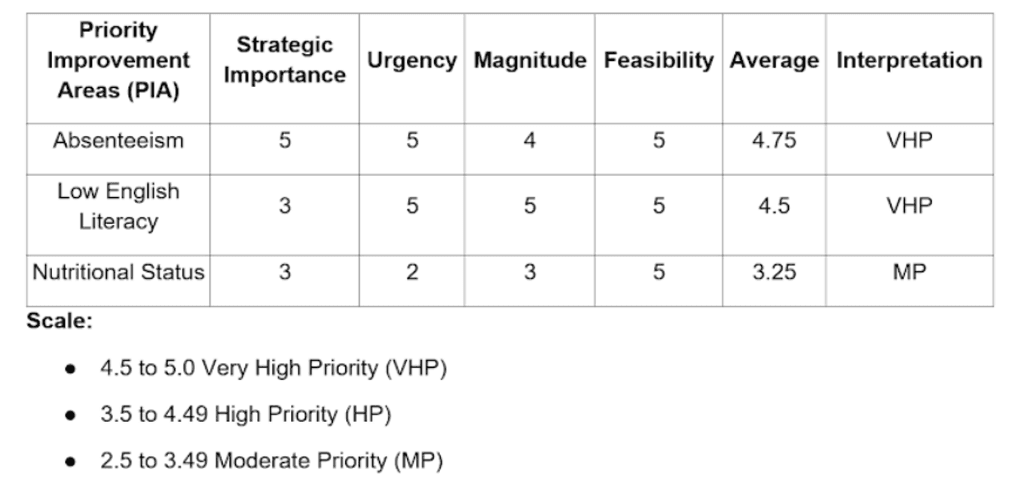
Basedon the meeting conducted by the School-Community Planning Team, they were ableto arrive at the Priority Improvement Areas below: What can be deduced from the data?
Basedon the table below, what help can a professional network offer to beginningschool heads in District III?
Summaryof Challenges for School Heads in District III
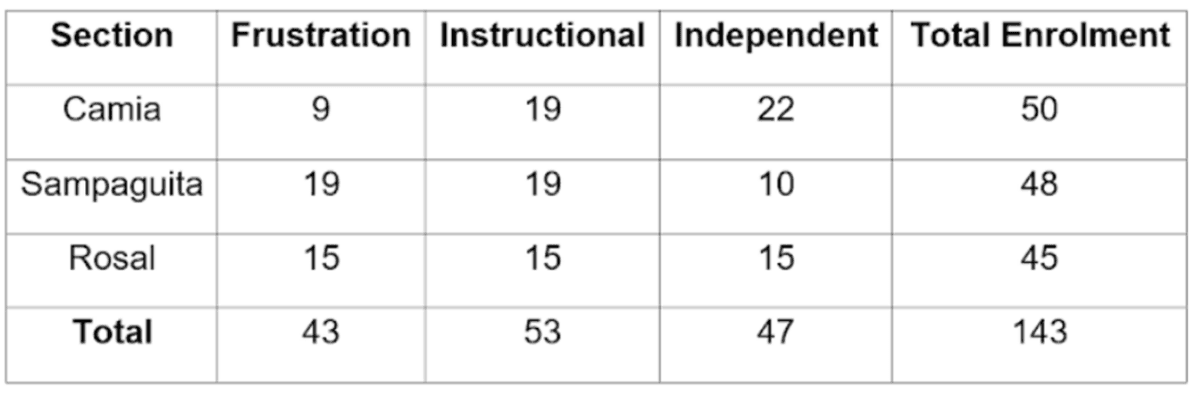
Thetable shows the reading levels of Grade 3 learners from the Philippine InformalReading Inventory (Phil-IRI) Pretest Results in School Year 2019–2020 in aparticular school.
Whatcan the principal infer from the table?