Our brand new solo games combine with your quiz, on the same screen

Correct quiz answers unlock more play!

New Quizalize solo game modes
48 questions
Show answers
  • Q1
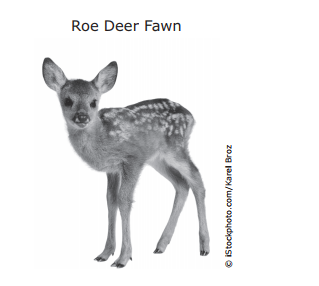
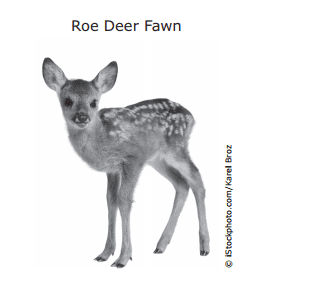
    In the European roe deer (Capreolus capreolus), implantation of embryos after breeding is delayed. The deer breed in July or August but do not give birth until the following May or June. From summer to late December, the embryo rests in a state of dormancy as a 30-cell blastocyst. In late December or early January, the embryo sends a signal that causes the female to release hormones, allowing the embryo to continue to develop normally. Why is delayed implantation an advantageous adaptation for the European roe deer?
    Question Image
    Delayed implantation enables the female to give birth to more fawns each year
    Delayed implantation allows the mother to continue to breed with other males
    Without delayed implantation, the females would not be able to carry a pregnancy to full term
    Without delayed implantation, the fawns would be born in the winter when food is scarce and the weather is harsh.
    60s
    BIOL.7e
  • Q2
    Parrotfish are herbivores that are found in coral reefs. To escape predation, a parrotfish will graze with a rabbitfish, which has venomous spines at the end of its pelvic fins. The rabbitfish does not benefit from this relationship. Which type of relationship do the parrotfish and the rabbitfish have in the coral-reef environment?Parrotfish are herbivores that are found in coral reefs. To escape predation, a parrotfish will graze with a rabbitfish, which has venomous spines at the end of its pelvic fins. The rabbitfish does not benefit from this relationship. Which type of relationship do the parrotfish and the rabbitfish have in the coral-reef environment?
    Commensal
    Predator-prey
    Parasitic
    Mutualistic
    60s
    BIOL.12a
  • Q3
    A segment of DNA produces methionine, threonine, histidine, aspartate, and glycine when translated. A substitution mutation occurs and causes the synthesis of the segment as shown. Which is the new peptide chain when the new DNA segment is translated?
    Question Image
    Methionine, proline, histidine, aspartate, glycine
    Methionine, phenylalanine, histidine, aspartate, glycine
    Methionine, serine, histidine, aspartate, glycine
    Methionine, leucine, histidine, aspartate, glycine
    60s
    BIOL.6e
  • Q4
    As ecosystems move through the stages of succession, the populations of organisms in them change. Which of the following describes the stage of succession likely to have the most species diversity?
    An agricultural field that has not been plowed for one year
    A field that is regularly mowed
    A temperate forest that has never been cleared by logging
    A newly formed volcanic island
    60s
    BIOL.11b
  • Q5
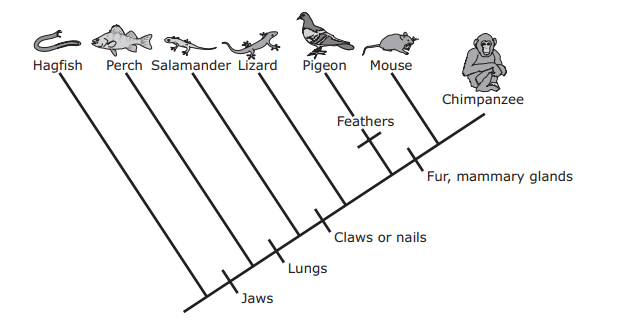
    Frogs and toads belong to the order Anura. The smallest organism in this order is about 7 millimeters long, while the largest member is about 30 centimeters long. Which of these lists best describes this order?
    Answer Image
    Answer Image
    Answer Image
    Answer Image
    60s
    BIOL.8b
  • Q6
    On March 24, 1989, an oil tanker ran aground on Bligh Reef in Prince William Sound, Alaska, and spilled millions of liters of crude oil. The graph shows pink salmon populations in Prince William Sound from 1970 to 1999. What do these data suggest about the effect the oil spill had on pink salmon?
    Question Image
    Pink salmon were nearly eliminated after the oil spill.
    Pink salmon populations steadily declined in the 10 years following the spill.
    Pink salmon populations seemed to be minimally affected.
    Pink salmon populations declined and never fully recovered.
    60s
    BIOL.12e
  • Q7
    Cells typically respond to DNA damage in three ways: by ceasing to grow and divide until the damage is repaired, by permanently ceasing to grow and divide, or by dying. In 2010 a group of scientists reported that a certain kind of immune reaction can cause DNA damage that leads to a fourth response. DNA damage can turn off genes involved in cell-signaling pathways. Turning off these genes can cause less-mature cells to divide too rapidly, often leading to the development of -
    hemophilia
    tumors
    allergies
    cardiovascular disease
    60s
    BIOL.5b
  • Q8
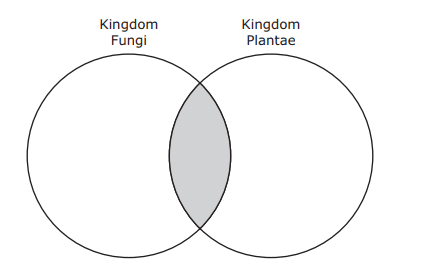
    A student wants to use the Venn diagram below to show the characteristics of two kingdoms of organisms. The characteristics that the two kingdoms share will be listed in the shaded area where the circles intersect. Which of these is a characteristic that the student should list in the shaded part of the diagram?
    Question Image
    Multicellular
    Mobile
    Prokaryotic
    Heterotrophic
    60s
    BIOL.8c
  • Q9
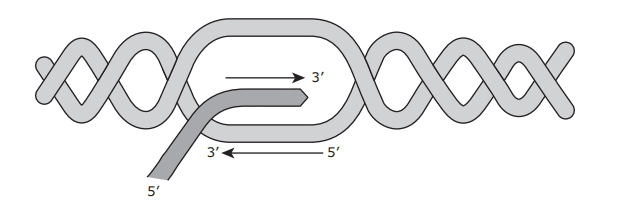
    Part of an important cellular process involving a DNA strand is modeled below. What is the purpose of this cellular process?
    Question Image
    Deleting the information in the sequence produced from the DNA template
    Preserving genetic information for future generations
    Producing more nucleotides for the DNA sequence
    Transcribing information in the DNA sequence for use by the cell
    60s
    BIOL.6c
  • Q10
    A student preparing for a hike wants to pack a snack that has biomolecules that provide quickly available energy but few excess calories. Which nutrition label lists the best combination of biomolecules that provide quickly available energy while providing the fewest calories from other types of biomolecules?
    Answer Image
    Answer Image
    Answer Image
    Answer Image
    60s
    BIOL.9a
  • Q11
    Organisms can be classified based on homology, which is shared characteristics inherited from a common ancestor. In the past, homologies were based on studies of anatomical structures and patterns of embryonic development. In more recent years, the use of molecular biology techniques has allowed homologies to be compared at the level of nucleotide sequences. Nucleotide sequence comparisons are possible because all organisms share which of the following?
    DNA bases
    Division of the nuclear chromosomes
    Types of proteins needed for cellular functions
    Cellular organelles
    60s
    BIOL.6b
  • Q12
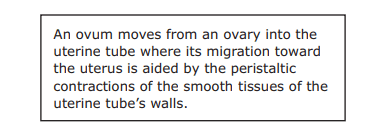
    An informational pamphlet in a health clinic describes an interaction between body systems. Which statement identifies the body systems that are directly involved in the interaction described and explains how they accomplish the interaction?
    Question Image
    The excretory system expels the ovum from the ovary, and the nervous system causes the contractions of the smooth tissues of the uterine wall
    The reproductive system produces the ovum, and the muscular system causes the migration of the ovum by peristaltic contractions
    The circulatory system supplies the uterine wall with oxygenated blood, and the immune system prevents damage to the ovum
    The nervous system produces hormones that stimulate the ovum, and the circulatory system moves the ovum into the uterine tube
    60s
    BIOL.10a
  • Q13
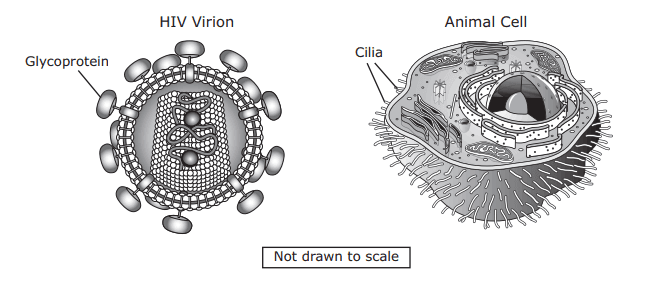
    Models of the human immunodeficiency virus (HIV) and an animal cell are shown below. What is the difference in the function of the glycoprotein structures of an HIV virion and the cilia of an animal cell?
    Question Image
    The glycoprotein structures are used to provide physical support for the viral envelope, and the cilia strengthen the cell membrane
    The glycoprotein structures are used for attachment, and the cilia are used to move fluids surrounding the cell
    The glycoprotein structures are used to obtain nutrition, and the cilia are used to secrete proteins
    The glycoprotein structures are used for defense, and the cilia are used for locomotion
    60s
    BIOL.4c
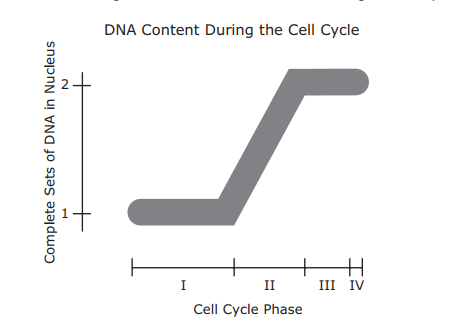
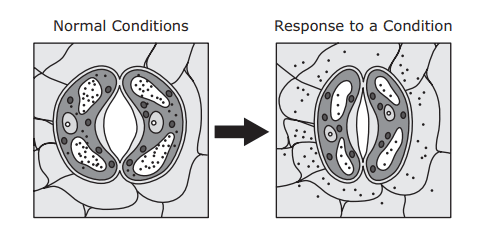
  • Q14
    60s
    BIOL.9b
  • Q15
    Two populations of mice living in the same forest are separated by a large water-filled ditch. After a rainstorm, flooding brings several mice from one population to the other population. When the mice from the first population reproduce with members of the second population, which of the following will likely occur?
    All the offspring will die as a result of reproductive mutations
    The offspring will be genetically identical to their parent from the first population
    The offspring in the second population will have greater genetic variety
    The offspring will be forced to leave the second population
    60s
    BIOL.7f

Teachers give this quiz to your class