Our brand new solo games combine with your quiz, on the same screen

Correct quiz answers unlock more play!

New Quizalize solo game modes
12 questions
Show answers
  • Q1
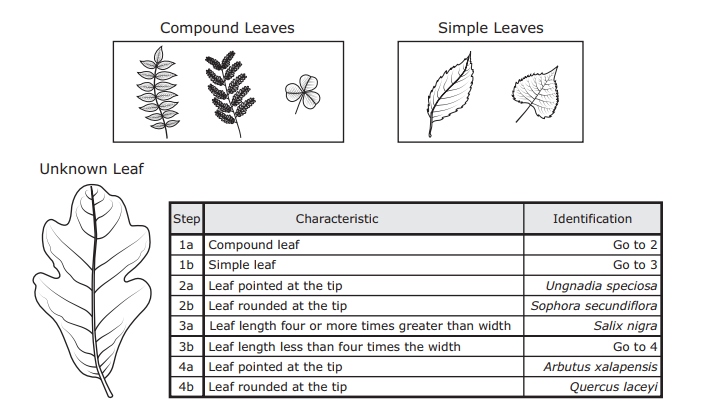
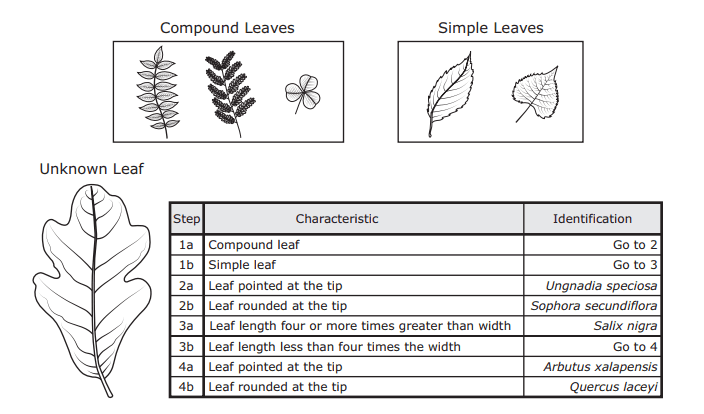
    Simple leaves have a single leaf on a petiole, or stem, while compound leaves have more than one leaflet on a petiole. This unknown leaf can be identified using the dichotomous key. Which tree does the unknown leaf come from?
    Question Image
    Sophora secundiflora
    Quercus laceyi
    Ungnadia speciosa
    Salix nigra
    30s
    B.8.B: Hierarchical Classification
  • Q2
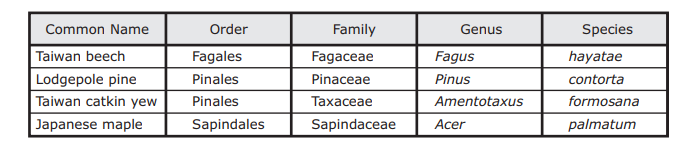
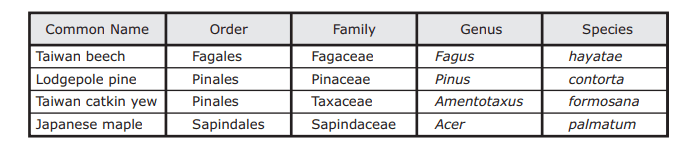
    The classifications of four trees are shown in the table. Which two trees are the most closely related?
    Question Image
    Taiwan beech and Taiwan catkin yew
    Taiwan catkin yew and lodgepole pine
    Lodgepole pine and Japanese maple
    Japanese maple and Taiwan beech
    30s
    B.8.B: Hierarchical Classification
  • Q3
    While visiting a national park, a student encounters an unfamiliar organism in a damp area near a body of water. The student notes that the organism is about 10 cm long, has four legs, and has a tail. The organism is black with small white spots on its smooth, moist skin. It also appears to have an internal skeletal system. To which class does the organism most likely belong?
    Insecta
    Mammalia
    Amphibia
    Reptilia
    30s
    B.8.B: Hierarchical Classification
  • Q4
    This dichotomous key can be used to identify some conifers. Based on the key, which of these best describes the leaves and cones of the longleaf pine?
    Question Image
    Needle-like straight leaves with a length of 25 cm that are mostly found in clusters of five; thorny cones
    Flattened and scale-like leaves that are mostly over 25 cm long; soft and leathery cones
    Needle-like straight leaves that are mostly over 25 cm long and found in clusters of three; no thorns on cones
    Leaves with a length of 25 cm that are found in clusters of more than five; no thorns on cones
    30s
    B.8.B: Hierarchical Classification
  • Q5
    Frogs and toads belong to the order Anura. The smallest organism in this order is about 7 millimeters long, while the largest member is about 30 centimeters long. Which of these lists best describes this order?
    Answer Image
    Answer Image
    Answer Image
    Answer Image
    45s
    B.8.B: Hierarchical Classification
  • Q6
    A cladogram is shown below. All the animals to the right of the hagfish would have the common characteristic of —
    Question Image
    jaws
    fur
    claws or nails
    lungs
    45s
    B.8.B: Hierarchical Classification
  • Q7
    Using a light microscope, a student identified the following characteristics of four organisms found in a sample of pond water. Based on the observations of the student, which organisms most likely belong to the taxonomic group for bacteria?
    Question Image
    Organisms 1 and 4
    Organisms 1 and 2
    Organisms 3 and 4
    Organisms 2 and 3
    30s
    B.8.B: Hierarchical Classification
  • Q8
    The diagram shows a dichotomous key and a picture of a fruit. According to the key, the fruit comes from which species of tree?
    Question Image
    Acer platanoides
    Fraxinus nigra
    Acer negundo
    Fraxinus americana
    30s
    B.8.B: Hierarchical Classification
  • Q9
    A student collected the animal shown below on a field trip. The student used a dichotomous key and a microscope to classify the animal. How should this animal be classified?
    Question Image
    Platyhelminthes
    Arthropoda
    Mollusca
    Annelida
    30s
    B.8.B: Hierarchical Classification
  • Q10
    Arthropods are joint-legged animals. Spiders, crabs, pill bugs, centipedes, and millipedes are examples of the many types of arthropods. Which of these arthropods are most closely related?
    Arthropods of the same genus
    Arthropods of the same class
    Arthropods of the same species
    Arthropods of the same family
    30s
    B.8.B: Hierarchical Classification
  • Q11
    A student used a microscope to study four members of the phylum Ciliophora. Members of this phylum move when propelled by hundreds of tiny cilia. Although these organisms belong to the same phylum, they are classified as different -
    Question Image
    orders
    families
    kingdoms
    species
    60s
    B.8.B: Hierarchical Classification
  • Q12
    The relationships among different orders of millipedes are shown in the cladogram.Based on this cladogram, which statement best describes relationships among millipede orders?
    Question Image
    Stemmiulida is more closely related to Merocheta than Penicillata is to Merocheta.
    Spirostreptida is more closely related to Glomerida than Sphaerotheriida is to Glomerida.
    Merocheta is more closely related to Glomeridesmida than Glomerida is to Glomeridesmida.
    Polyzoniida is more closely related to Glomeridesmida than Sphaerotheriida is to Glomeridesmida.
    60s
    B.8.B: Hierarchical Classification

Teachers give this quiz to your class