TEKS HS Biology - BIOL.7E Adaptation & Diversity
Quiz by Biology - Texas Education Agency
High School
Biology(2017)(ARCHIVED)
Texas Essential Knowledge and Skills (TEKS)
Feel free to use or edit a copy
includes Teacher and Student dashboards
Measures 1 skill from
Track each student's skills and progress in your Mastery dashboards
With a free account, teachers can
- edit the questions
- save a copy for later
- start a class game
- automatically assign follow-up activities based on students’ scores
- assign as homework
- share a link with colleagues
- print as a bubble sheet
12 questions
Show answers
- Q1Some organisms have genes that improve their ability to survive and reproduce. If the genes also help their offspring survive and reproduce, then which of the following will most likely increase?The frequency of the genes in one individualThe number of genes in one chromosomeThe frequency of the genes in the populationThe number of genes in the species60sBIOL.7e
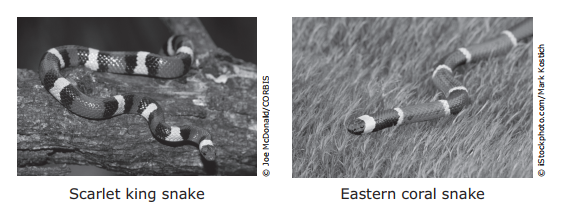
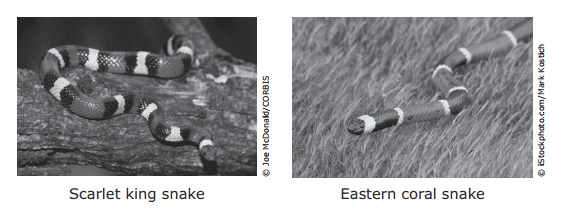
- Q2A harmless scarlet king snake and a venomous eastern coral snake have similar band patterns, as shown below. For the scarlet king snake, the adaptation of having a banding pattern like the eastern coral snake's is known as mimicry. The outcome of this adaptation in the scarlet king snake is to -make it easier for the scarlet king snake to attract preyallow the scarlet king snake to blend in with its environmentmake it easier for the scarlet king snake to interbreed with the other snakeprotect the scarlet king snake from predators60sBIOL.7e
- Q3Scientists estimate that there are more than 20,000 species of ants. The species range in size from 1 mm long to 38 mm long and live in most environments. The diets of ants range from flowers and seeds to fluids from their own larvae. Ants have been able to successfully inhabit so many different environments because their populations have been able to -adapt to a variety of habitats and food sourceshybridize with other species of insectsoccupy habitats that have no other life-formsfill niches usually occupied by mammals60sBIOL.7e
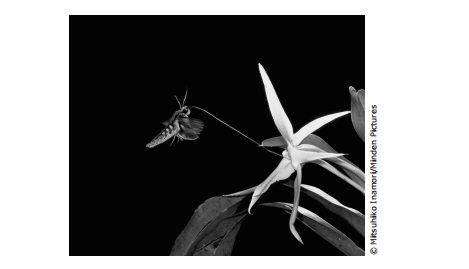
- Q4In Madagascar scientists have discovered a moth, Xanthopan morganii praedicta, that has a 30.5 cm proboscis and feeds from and pollinates Darwin's orchid, Angraecum sesquipedale. The orchid has a nectar-producing tube that is 27.9 cm long. How is the moth's proboscis size an adaptation for its environment?The moth can pollinate other flowersThe moth has little competition for foodThe moth has time to feed during the dayThe moth can avoid larger animals60sBIOL.7e
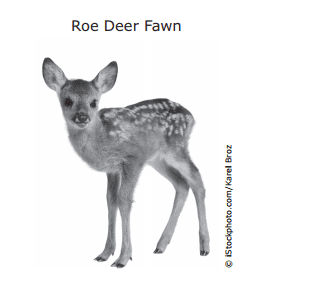
- Q5In the European roe deer (Capreolus capreolus), implantation of embryos after breeding is delayed. The deer breed in July or August but do not give birth until the following May or June. From summer to late December, the embryo rests in a state of dormancy as a 30-cell blastocyst. In late December or early January, the embryo sends a signal that causes the female to release hormones, allowing the embryo to continue to develop normally. Why is delayed implantation an advantageous adaptation for the European roe deer?Delayed implantation enables the female to give birth to more fawns each yearDelayed implantation allows the mother to continue to breed with other malesWithout delayed implantation, the females would not be able to carry a pregnancy to full termWithout delayed implantation, the fawns would be born in the winter when food is scarce and the weather is harsh.60sBIOL.7e
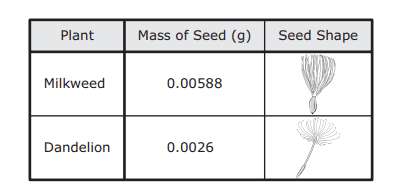
- Q6Plants have developed many methods of seed dispersal. The table below shows seeds of two different plants. How has the seed dispersal method developed by these plants given them a reproductive advantage?The method reduces the chance that herbivores will consume the seedsThe method lengthens the life cycle of each of these plantsThe method reduces the plants' need for water and other nutrientsThe method ensures that offspring will be dispersed and reduces competition for resources60sBIOL.7e
- Q7A prey population consists of individuals with a variety of running speeds. The adaptation that allows some of these animals to run fast would be an example of natural selection if it helps them -produce offspring that run at average speedslower the mortality rates of the populationsurvive and undergo mutations in their DNAreproduce and increase the frequency of their genes in the population60sBIOL.7e
- Q8Nudibranchs are marine gastropods that lack shells. Many of these gastropods retain the foul-tasting poisons of their prey and secrete them when threatened. The bright coloration of the nudibranchs warns predators to avoid them. Based on this information, how has adaptation allowed marine gastropods to be successful without a shell?They blend in with their environment to hide from their predatorsThey have bright colors that attract a mate.They are not attacked by most predators and are able to reproduce successfullyThey find enough food as they move through the marine environment60sBIOL.7e
- Q9In the 1940s, the scientist J. B. S. Haldane linked many human red blood cell disorders with the tropical regions where malaria occurs. Haldane hypothesized that the widespread presence of these red blood cell disorders as well as traits that protect individuals from malaria were the result of natural selection. Haldane's hypothesis was later confirmed by the research of A. C. Allison. The resistance to malaria carried by individuals in areas where malaria is widespread is the result of -a vaccine against malariathe individuals' behavior in avoiding those with the infectionthe individuals' genetic compositionantibiotic medications60sBIOL.7e
- Q10The table shows the survival rate of two types of beetles in the same environment over a period of three years. Which statement about the beetles in this environment is best supported by the data?Brown beetles have a shorter life cycle than green beetles haveGreen beetles are more fit for the environment than brown beetles areGreen beetles have a greater gene frequency among their population than brown beetles haveBrown beetles undergo a greater number of unfavorable mutations than green beetles do60sBIOL.7e
- Q11The white cattail is a hybrid species of plant that is a result of the cross between the broad-leaved cattail and the narrow-leaved cattail. Over time, the white cattail has established itself in the wetlands of Midwestern states. Which of these explains the success of the white cattail?Hybridization produces offspring traits that allow different species to survive in extreme environments.Hybrid species display more adaptations due to their reduced genetic diversity.Inherited traits passed on from parental generations make hybrid species more susceptible to disease.Favorable genes from parental generations provide advantageous characteristics to the hybrid species.60sBIOL.7e
- Q12Adaptations that result from natural selection are expected to increase the fitness of an organism. In terms of natural selection, which of the following best describes fitness?Being able to escape from predatorsBeing able to survive long enough to reach the adult stageBeing able to survive, find a mate, and produce offspringBeing among the strongest organisms in a population60sBIOL.7e