describe the contributions of significant political, social, and military leaders of the United States such as Frederick Douglass, John Paul Jones, James Monroe, Stonewall Jackson, Susan B. Anthony, and Elizabeth Cady Stanton
analyze reasons for and the impact of selected examples of civil disobedience in U.S. history such as the Boston Tea Party and Henry David Thoreau's refusal to pay a tax
explain the role of significant individuals such as Thomas Hooker, Charles de Montesquieu, John Locke, William Blackstone, and William Penn in the development of self-government in colonial America
summarize a historical event in which compromise resulted in a peaceful resolution
Track each student's skills and progress in your Mastery dashboards
Give this quiz to my class
Q 1/18
Score 0
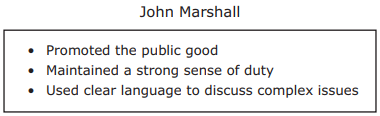
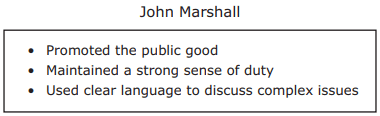
Which action should be added to this list?
60
Wrote the Supreme Court decision that established the principle of judicial review
Supported the popular election of Supreme Court justices
Upheld the doctrine of states’ rights
Allowed slavery to extend into western territories
Q 2/18
Score 0
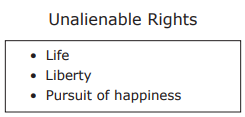
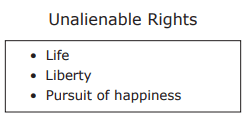
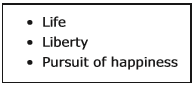
The rights listed above were —
60
defined by President George Washington in his Farewell Address
established by the ratification of the U.S. Constitution
defined by Thomas Jefferson in the Declaration of Independence
established by a series of Supreme Court decisions
18 questions
Q.
Which action should be added to this list?
1
60 sec
8.22.A: Social Studies - Citizenship
Q.
The rights listed above were —
2
60 sec
8.19.A: Social Studies - Citizenship
Q.
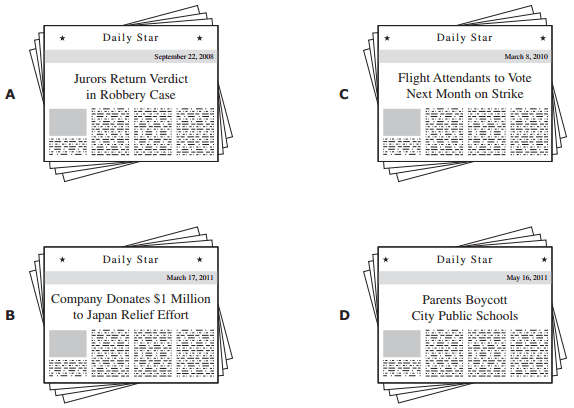
Which headline provides the best example of a civic duty?
3
60 sec
8.19.D: Social Studies - Citizenship
Q.
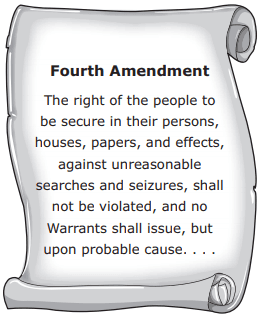
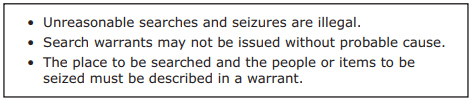
The constitutional amendment excerpted above protects people in the United States from —
4
60 sec
8.19.B: Social Studies - Citizenship
Q.
A biography on the military career of General Thomas “Stonewall” Jackson would include his involvement in which Civil War events?
5
60 sec
8.22.B: Social Studies - Citizenship
Q.
Which of these completes this graphic organizer?
6
60 sec
8.20.C: Social Studies - Citizenship
Q.
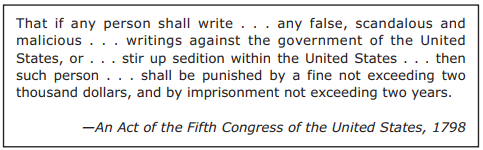
Which constitutional guarantee did this act violate?
7
60 sec
8.19.B: Social Studies - Citizenship
Q.
This list includes rights that are considered —
8
60 sec
8.19.A: Social Studies - Citizenship
Q.
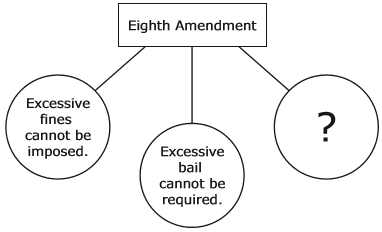
Which sentence completes this diagram?
9
60 sec
8.19.B: Social Studies - Citizenship
Q.
John Hancock was one of the Founding Fathers committed to liberty. How did he demonstrate this commitment?
10
60 sec
8.20.B: Social Studies - Citizenship
Q.
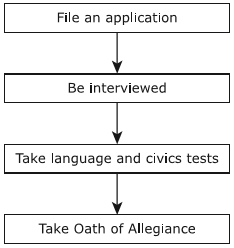
This diagram shows some of the steps in becoming a —
11
60 sec
8.19.E: Social Studies - Citizenship
Q.
When citizens report for jury duty, they are helping uphold a constitutional right guaranteed by the —
12
60 sec
8.19.B: Social Studies - Citizenship
Q.
This excerpt refers to rights that people —
13
60 sec
8.19.A: Social Studies - Citizenship
Q.
In 1787, Congress awarded John Paul Jones the Congressional Gold Medal in honor of his “valor and brilliant services” during the Revolutionary War. Which accomplishment was Congress recognizing?
14
60 sec
8.22.B: Social Studies - Citizenship
Q.
Which feature of colonial self-government does this charter establish?
15
60 sec
8.20.A: Social Studies - Citizenship
Q.
Which amendment provides for the protections described in this list?
16
60 sec
8.19.B: Social Studies - Citizenship
Q.
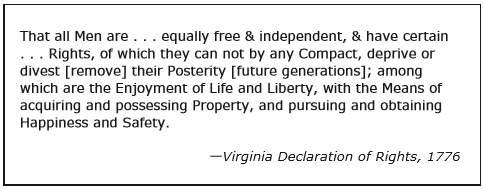
In this excerpt, the authors of the Virginia Declaration of Rights are describing rights they consider —
17
60 sec
8.19.A: Social Studies - Citizenship
Q.
What was a major result of the Missouri Compromise?