Understand subtraction of rational numbers as adding the additive inverse, p - q = p + (-q). Show that the distance between two rational numbers on the number line is the absolute value of their difference, and apply this principle in real-world contexts.
Understand that multiplication is extended from fractions to rational numbers by requiring that operations continue to satisfy the properties of operations, particularly the distributive property, leading to products such as (-1)(-1) = 1 and the rules for multiplying signed numbers. Interpret products of rational numbers by describing real-world contexts.
Understand p + q as the number located a distance |q| from p, in the positive or negative direction depending on whether q is positive or negative. Show that a number and its opposite have a sum of 0 (are additive inverses). Interpret sums of rational numbers by describing real-world contexts.
Understand that integers can be divided, provided that the divisor is not zero, and every quotient of integers (with non-zero divisor) is a rational number. If p and q are integers, then -(p/q) = (-p)/q = p/(-q). Interpret quotients of rational numbers by describing real-world contexts.
Track each student's skills and progress in your Mastery dashboards
Give this quiz to my class
Q 1/36
Score 0
60
Q 2/36
Score 0
Altitude above sea level is given in positive values and below sea level is given in negative values. Which situation describes a hiker in Death Valley stopping at an altitude of 0 feet?
60
The hiker starts at −10 feet then decreases altitude by 10 feet.
The hiker starts at −10 feet then increases altitude by 10 feet.
The hiker starts at 10 feet then increases altitude by 10 feet.
The hiker starts at 0 feet then decreases altitude by 10 feet.
36 questions
Q.
1
60 sec
7.NS.A.1.D
Q.
Altitude above sea level is given in positive values and below sea level is given in negative values. Which situation describes a hiker in Death Valley stopping at an altitude of 0 feet?
2
60 sec
7.NS.A.1.A
Q.
3
60 sec
7.NS.A.3
Q.
4
60 sec
7.NS.A.2.A
Q.
5
60 sec
7.NS.A.2.D
Q.
6
60 sec
7.NS.A.3
Q.
7
60 sec
Q.
8
60 sec
7.NS.A.3
Q.
9
60 sec
7.NS.A.3
Q.
10
60 sec
7.NS.A.1.B
Q.
11
60 sec
7.NS.A.1.C
Q.
12
60 sec
7.NS.A.2.D
Q.
13
60 sec
7.NS.A.2.A
Q.
14
60 sec
7.NS.A.2.D
Q.
15
60 sec
7.NS.A.1.A
Q.
16
60 sec
7.NS.A.3
Q.
17
60 sec
7.NS.A.2.C
Q.
18
60 sec
7.NS.A.2.D
Q.
19
60 sec
7.NS.A.3
Q.
20
60 sec
7.NS.A.1.A
Q.
21
60 sec
7.NS.A.3
Q.
22
60 sec
7.NS.A.1.D
Q.
23
60 sec
7.NS.A.1.C
Q.
24
60 sec
7.NS.A.2.D
Q.
25
60 sec
7.NS.A.1.A
Q.
26
60 sec
Q.
27
60 sec
7.NS.A.1.C
Q.
28
60 sec
7.NS.A.1.A
Q.
29
60 sec
7.NS.A.2.C
Q.
30
60 sec
7.NS.A.1.D
Q.
31
60 sec
7.NS.A.2.C
Q.
32
60 sec
7.NS.A.3
Q.
33
60 sec
7.NS.A.2.C
Q.
34
60 sec
7.NS.A.1.C
Q.
35
60 sec
7.NS.A.2.B
Q.
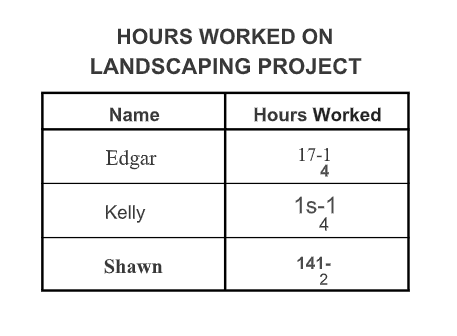
Three friends own a landscaping business. The number of hours each friend spent on the same project is shown in the table below.
In total, they earned $850 for the job . They put 15% of this amount into a joint savings account for future expenses. They then divided the rest proportionally based on the number of hours each worked. How much money did Shawn receive?