Loading...


Unit 1 - Mendelian & Non-Mendelian Genetics, Genetic Engineering
Quiz by RALPH JOSEPH SEVILLA
Tag the questions with any skills you have. Your dashboard will track each student's mastery of each skill.
These are DNA sections that code for specific proteins or functional RNA, playing a crucial part in biological functions.
Variations of genes, leading to diverse traits such as eye color.
Can be dominant (X) or recessive (x)
It refers to how patterns arise when parents pass on their traits onto their offspring.
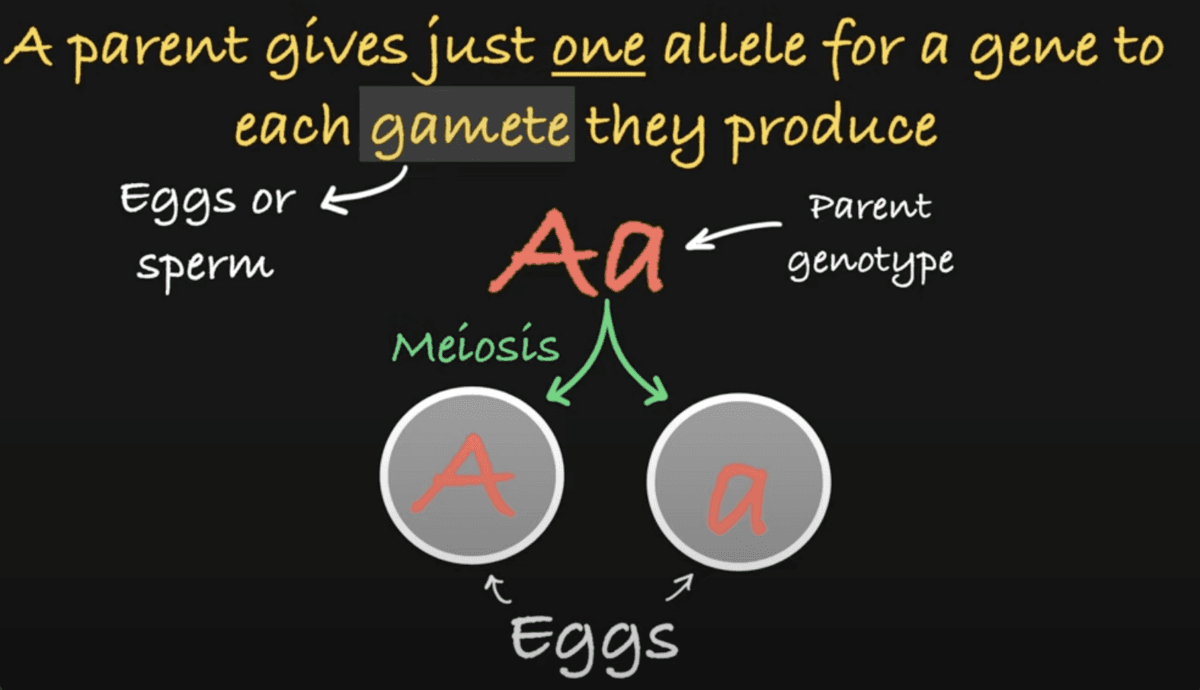
This law of mendelian genetics states that each gamete (sperm or egg cell) made by an organism will just get one of the two gene copies present in a parent organism, and that the gene copies are randomly allocated to the gametes.
For instance, if an organism has a genotype of Aa, half of its gametes will contain an A allele, and the other half will contain an a allele.
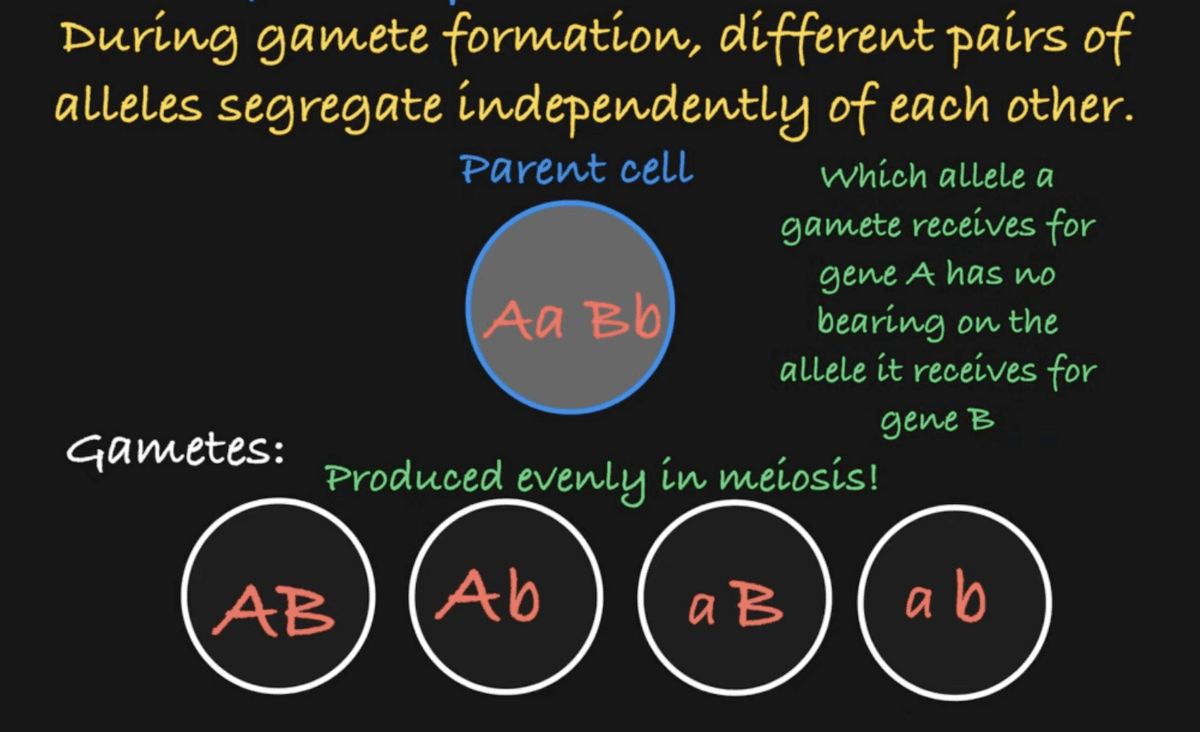
This law of mendelian genetics states that that the alleles of two (or more) different genes get sorted into gametes independently of one another.
In other words, the allele a gamete receives for one gene does not influence the allele received for another gene.
For example, if a gamete receives the recessive allele for gene A, it does not affect the allele it receives for gene B.
A group of researchers are studying stem length inheritance in the garden pea plant (Pisum sativum).
They obtain a tall pea plant of unknown ancestry, allow it to self-pollinate, and collect 80 of its seeds. After planting the seeds, they observe the growth of 61 tall plants and 19 dwarf plants.
Which of the following best explains the stem lengths seen in the offspring?
Huntington’s disease is a rare inherited disorder caused by an autosomal dominant allele of the huntingtin gene. As individuals with the disease age, their neurons degenerate at an accelerated rate compared to individuals without the disease.
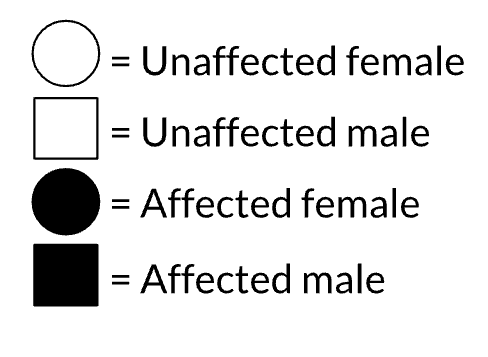
Which of the following pedigrees shows a likely pattern of inheritance in a family with a history of Huntington’s disease?
A group of students are studying flower color inheritance in the garden pea plant (Pisum sativum). They obtain a purple-flowered pea plant of unknown ancestry, allow it to self-pollinate, and collect 60 of its seeds. After planting the seeds, they observe the growth of 42 purple-flowered plants and 18 white-flowered plants.
Which of the following best explains the flower colors seen in the offspring?
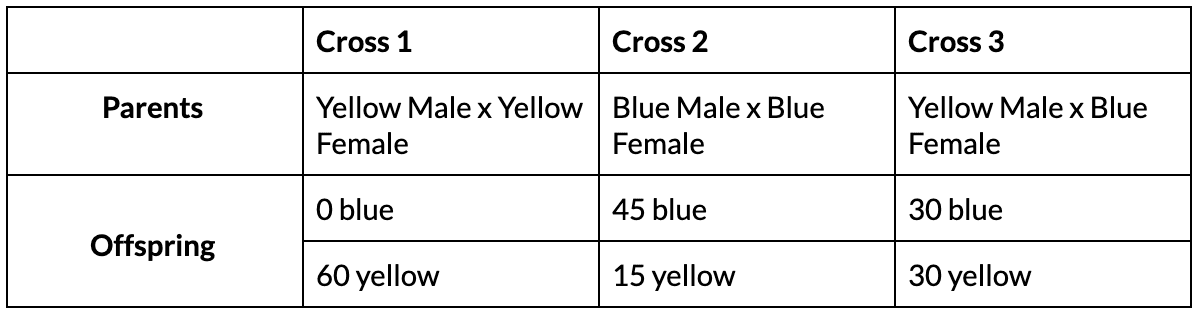
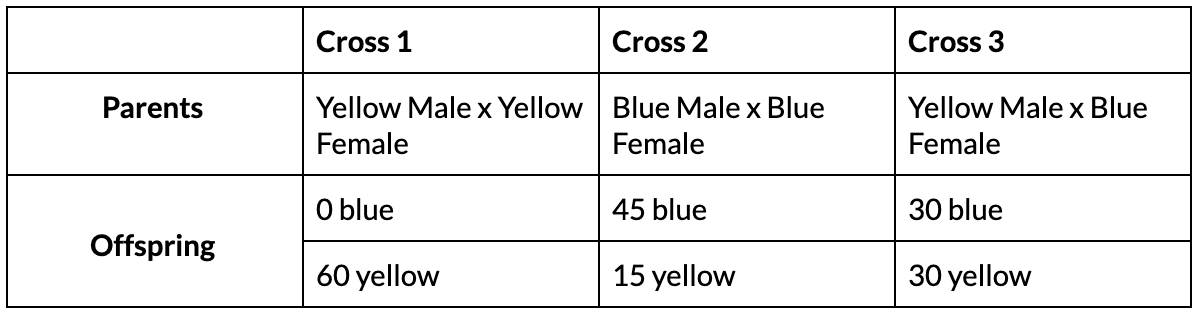
The data depicted represents the results of three different crosses in which a single gene determines whether a certain organism is blue or yellow.Which of the following best describes how this gene is inherited from parents to offspring?
It is a pattern of non-mendelian genetics where two alleles are both expressed as a dominant phenotype.
This means that both alleles are manifested in the offspring.
It is a pattern of non-mendelian genetics where a gene exists in more than two allelic forms.
A great example of this is an individual's Blood Type.
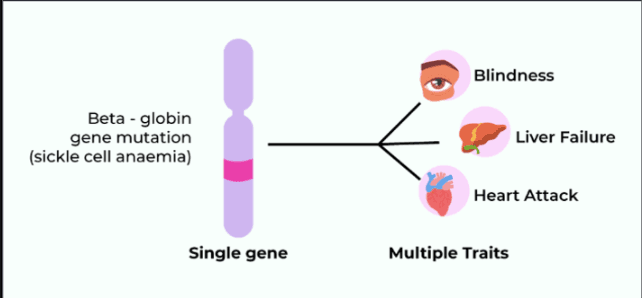
The phenomenon in which a single locus affects two or more apparently unrelated phenotypic traits and is often identified as a single mutation that affects two or more traits.
An example of this is sickle-cell anaemia, wherein a mutation in the Beta-globin gene leads to multiple deficiencies and disorders in the body.
Traits which can be influenced by two or more genes.
Common examples are height and skin color. This explains why height in particular varies so much in a population.
A cross between a white rooster and a black hen results in 100% blue Andalusian offspring. When two of these blue offspring are mated, the probable phenotypic ratio seen in their offspring would be _____.
Because the gene for red-green color blindness is located on the X chromosome, it is normally not possible for a _____.
A man heterozygous for blood type A marries a woman heterozygous for blood type B. The chance that their child will have type O blood is _____.
Assume that in these animals, females carry XX sex chromosomes while males carry XY chromosomes.
Based on the data in the table, which of the following statements best explains the inheritance pattern seen for the body color trait?
Sickle cell anemia is a recessive trait.
A woman with sickle cell anemia disease has a child with a homozygous normal man (with no family history of sickle cell disease). What is the probability that this couple will have a homozygous normal child?
Family relationships are displayed using _____.