Loading...


Unit 3 Review - Constitutional Convention
Quiz by Corina Allen
Tag the questions with any skills you have. Your dashboard will track each student's mastery of each skill.
During the Revolutionary War, the United States formed a national government under the Articles of Confederation. A confederation is a union of independent states with a common goal. The Articles of Confederation unified the states enough to win the war and achieve independence. But after the war, when the common goal became governing the new nation, the Articles of Confederation did not give enough power to the national government.
The Articles of Confederation led to several problems for the new nation.
Match each problem to the feature of the Articles of Confederation that caused it.
In 1786, farmers and former soldiers unable to pay their taxes began a violent uprising known as Shays' Rebellion. Although the attacks were eventually stopped, the government's limited ability to respond convinced many people that the nation needed a stronger national government. The following year, every state except Rhode Island sent delegates to a historic meeting called the Constitutional Convention. Their goal was to replace the Articles of Confederation with a new constitution.
The 55 delegates to the convention became known as the Framers. James Madison was one of the leading delegates, contributing many ideas and keeping detailed records.
Read an excerpt from a letter written by Madison at the start of the convention. Then answer the question below.
Our affairs are considered on all hands as at a most serious crisis. No hope is entertained from the existing [government structure]. And the eyes and hopes of all are turned towards this new assembly. The result therefore whatever it may be must have a material (significant) influence on our destiny.
Based on Madison's description, which statements about the delegates are true? Select all that apply.
One of the first things the delegates agreed on was the need to create a system that balanced state powers with a stronger national government. They created a new national government, called the federal government, with three distinct branches. These branches had powers that extended beyond those of the existing Congress of the Confederation.
Match each branch of the federal government to the problem it would solve.
The Framers created a government with three branches because they believed in the importance of an idea called separation of powers.
Read James Madison's analysis of the need for separation of powers. Then answer the question below.
The accumulation of all powers, legislative, executive, and judiciary, in the same hands, whether of one, a few, or many, and whether hereditary, self-appointed, or elective, may justly be pronounced the very definition of tyranny.
According to Madison, why is the separation of powers across three branches of government important?
The Framers agreed on some aspects of the new government. But their individual state interests led to disagreements on other key issues.
Read about some of these disagreements. Then follow the instructions below.
Representation in Congress: Large states favored representation by population. Small states argued for equal representation across all states.
State powers: Some delegates wanted the federal government to have the authority to overrule decisions by state governments. Other delegates wanted state decisions to be final.
Slavery: Some northern delegates wanted to ban slavery. Many southern delegates wanted slavery to continue.
Trade: Northern manufacturers wanted to impose tariffs, or taxes, on foreign goods. Southerners wanted to avoid paying higher prices for imported goods.
Use the information above to complete the text.
Delegates had to take their states' interests into account in every decision. Delegates from 1________ states did not want the population to determine representation in Congress. They wanted an equal voice in national decisions. Many 2________ delegates wanted the government to be able to tax foreign goods, which would give goods made in the states a price advantage. Delegates from the 3________ states were concerned that the federal government would outlaw slavery, which would force plantation owners to change the way they farmed. Many delegates did not want the federal government to have the authority to overrule 4________ decisions, for fear that their states would lose the ability to decide important issues for themselves.
Word bank:
1 all, large, small
2 northern, southern
3 northern, southern
4 state, executive
Separate your responses by a comma. Example: one, two, three
The organization of the legislative branch was one of the most contentious issues at the Constitutional Convention. Debates focused on the balance of power between large and small states. Two competing plans emerged.
Read about these plans. Then answer the question:
Which statements accurately describe differences between the two plans? Select all that apply.
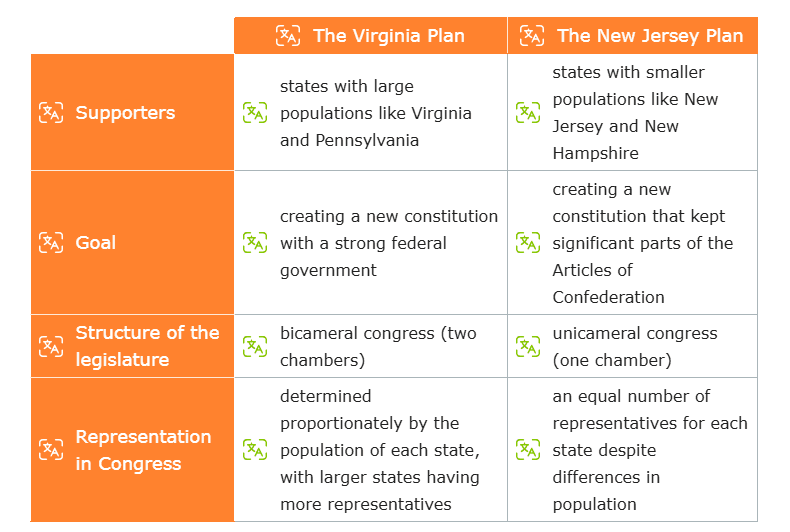
The following statements are some of the arguments that delegates made in support of either the Virginia Plan, which proposed representation based on population, or the New Jersey Plan, which proposed equal representation for each state.
Match each statement with its meaning.
Read the text and table. Then use what you learned in the table above to complete the text.
Separate your answers by a comma. Example: one, two, three
The Great Compromise proposed a 1____________ legislature, as the 2__________ Plan wanted. But each legislative chamber determined the representatives differently. In the Senate, the states got 3_____________ representation, as the Blank Plan wanted. In the House of Representatives, the states got 4______________ representation, as the 5__________ Plan. In this way, states with large and small populations got what they wanted.
Word bank: bicameral, unicameral, Virginia, New Jersey, equal, proportional
Words may be used more than once.

After compromising on the legislative branch, the convention turned to the executive branch. Here, the process for electing the president was the most contentious issue. The Framers admired the ancient Roman belief that citizens should choose their leaders. But they also worried that the general public wasn't capable of choosing wisely.
Below are some of the proposals for how the president could be elected.
Match each proposal to the response from delegates at the Constitutional Convention
Under the Articles of Confederation, the national government couldn't raise money or control trade policies. So, the Framers wrote the Constitution's commerce clause to give Congress the power to tax foreign goods and regulate trade. These changes would provide revenue for the federal government and increase the price of foreign goods, helping northern manufacturers sell their products.
But the commerce clause had one especially controversial implication: regulating trade would give Congress the ability to control, or even end, the slave trade. Southern delegates threatened to leave the union if Congress had the power to control the slave trade. So northern delegates agreed that, for 20 years, Congress would not pass laws banning slavery. This agreement is known as the Slave-Trade Compromise.
What did the Slave-Trade Compromise do? Select all that apply.
The divisive issue of slavery also affected proportional representation in Congress. Since larger populations meant more representatives in Congress, southern states wanted to count enslaved people in their recorded populations. Northern states disagreed. Slavery was less common in northern states, so counting enslaved populations for representation would not benefit them, and many northern states strongly opposed slavery.
To settle this issue, the Framers made a controversial decision called the Three-Fifths Compromise.
Read their decision, found in Article I of the Constitution. Then answer the question below.
Article I
Representatives and direct taxes shall be apportioned among the several states ... according to their respective numbers, which shall be determined by adding to the whole number of free persons...three fifths of all other persons... apportioned: assigned all other persons: enslaved people
Based on the description above, what did the Three-Fifths Compromise do?
Select all that apply
Individual state interests led to conflict over many issues discussed at the Constitutional Convention.
Use what you have learned to match each conflict to the compromise delegates eventually agreed to.
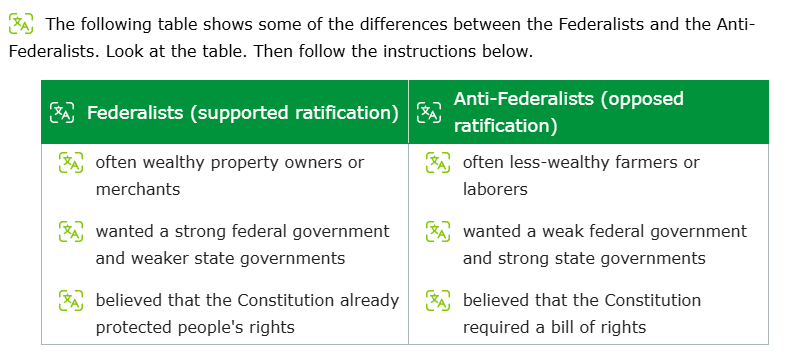
The three delegates who refused to sign the Constitution were part of a group called the Anti-Federalists. Some Anti-Federalists wanted to start over with a completely new constitution, while others wanted to modify the existing document by adding a bill of rights.
A bill of rights would guarantee protections for individual liberties such as freedom of speech and freedom of religion.
Read the statements below. Check the statements that represent an argument for adding a bill of rights.
During the ratification process, state governments reviewed the Constitution and prepared to vote to accept or reject it. The people arguing to approve the Constitution called themselves Federalists. James Madison, Alexander Hamilton, and John Jay wrote a series of essays called the Federalist Papers to convince the public to ratify the Constitution. These essays often covered topics such as:
-why the current government was too weak, and why the proposed federal government's powers were necessary
-why the separation of powers would prevent the federal government from becoming too powerful
-why the Constitution already protected individual rights by limiting government power
Based on these topics, what was the public's main concern about the Constitution?
Use the chart/statements representing either a Federalist or Anti-Federalist viewpoint on the proposed Constitution.