Loading...

Unit 4 Review
Quiz by McNally, Tiffany L.
Tag the questions with any skills you have. Your dashboard will track each student's mastery of each skill.
The map above shows the United States immediately following the
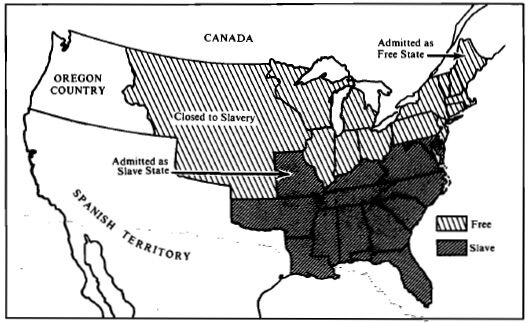
settlement of the Mexican War
passage of the Northwest Ordinance
passage of the Missouri Compromise
passage of the Compromise of 1850
negotiation of the Adams-Onis Treaty
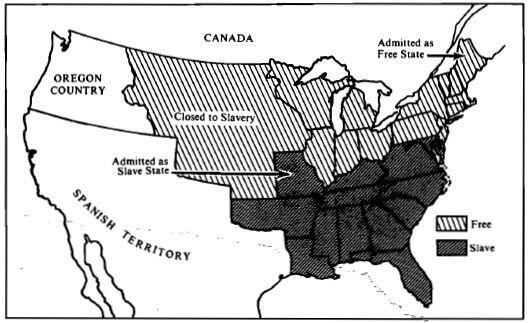
The map above shows the United States immediately following the
“To turn the administration of our civic affairs wholly over to men may mean that the American city will continue to push forward in its commercial and industrial development, and continue to lag behind in those things which make a city healthful and beautiful. . . . If women have in any sense been responsible for the gentler side of life which softens and blurs some of its harsher conditions, may they not have a duty to perform in our American cities? . . . [I]f woman would fulfill her traditional responsibility to her own children; if she would educate and protect from danger factory children who must find their recreation on the street . . . then she must bring herself to the use of the ballot—that latest implement for self-government.”
Jane Addams, “Why Women Should Vote,” Ladies’ Home Journal, 1910
Question
Addams’ ideas expressed in the excerpt have most in common with which of the following historical views about women?
During the first half of the nineteenth century, the central and western areas of New York were known as the “burned-over district” because
Which of the following most likely contributed to the emergence of the Second Great Awakening?
“In exercising the power of regulating their own purely internal affairs, whether of trading or police, the states may sometimes enact laws, the validity of which depends on their interfering with, and being contrary to, an act of Congress passed in pursuance of the Constitution. . . . Should this collision exist, it will be immaterial whether those laws were passed in virtue of a concurrent power to regulate commerce with foreign nations and among the several states, or in virtue of a power to regulate their domestic trade and police. . . .
“This court is of opinion that so much of the several laws of the state of New York as prohibits vessels, licensed according to the laws of the United States, from navigating the waters of the state of New York, by means of fire or steam, is repugnant to the said Constitution and void.”
United States Supreme Court, Gibbons v. Ogden, 1824
Question
The excerpt best reflects which of the following trends during the early 1800s?
Which of the following was NOT a result of the growth of a national market economy between 1815 and 1860 ?
Question refers to the excerpt below.
“Few historians would dispute that the market revolution brought substantial material benefits to most northeasterners, urban and rural.... Those who benefited most from the market revolution—merchants and manufacturers, lawyers and other professionals, and successful commercial farmers, along with their families—faced life situations very different from those known to earlier generations. The decline of the household as the locus of production led directly to a growing impersonality in the economic realm; household heads, instead of directing family enterprises or small shops, often had to find ways to recruit and discipline a wage-labor force; in all cases, they had to stay abreast of or even surpass their competitors.”
Sean Wilentz, historian, “Society, Politics, and the Market Revolution, 1815–1848,” published in 1997
Question
Which of the following historical developments contributed most directly to the market revolution?
The most unpopular and least successful of President Thomas Jefferson’s policies was his
The Louisiana Purchase proved politically troubling for Thomas Jefferson because of his
The issuance of the Monroe Doctrine did which of the following?
The Monroe Doctrine maintained that
The development of the Second Great Awakening can best be linked to which of the following historical situations?
“We, therefore, the people of the State of South Carolina, in convention assembled, do declare and ordain... that the several acts and parts of acts of the Congress of the United States, purporting to be laws for the imposing of duties and imposts on the importation of foreign commodities...are unauthorized by the Constitution of the United States, and violate the true meaning and intent thereof and are null, void, and no law, nor binding upon this State....”
South Carolina Ordinance of Nullification, 1832
Question
The ideas expressed in the excerpt emerged most directly from a larger intellectual debate over the
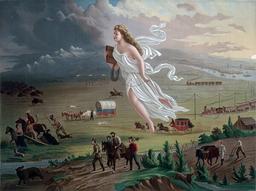
What was the purpose behind the publication of the 1840 illustration above?

