Tag the questions with any skills you have. Your dashboard will track each student's mastery of each skill.
Give this quiz to my class
Q 1/20
Score 0
The Nullification Crisis of 1832 centered around
30
the annexation of Texas.
decreased trade with France.
southern opposition to tariffs.
Jackson's War on the Bank.
Q 2/20
Score 0
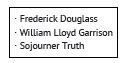
All of these were prominent names were figures in WHICH social movement?
30
prison reform
prohibition
states rights
abolition
20 questions
Q.
The Nullification Crisis of 1832 centered around
1
30 sec
Q.
All of these were prominent names were figures in WHICH social movement?
2
30 sec
Q.
Which event is the BEST example of a conflict over states' rights?
3
30 sec
Q.
Who was the most vocal opponent of the Tariff of 1828 and advocated "State's Rights" and "Nullification" in the growing sectional conflicts between North and South?
4
30 sec
Q.
Angelina and Sarah Grimke were sisters from South Carolina and are MOST notable as being 19th century
5
30 sec
Q.
Which of these BEST describes the efforts of William Lloyd Garrison?
6
30 sec
Q.
How did the Missouri Compromise deal with the issue of slavery?
7
30 sec
Q.
Calhoun's opinions regarding the Tariff of 1828 reflect the political philosophy behind the ___ movement
8
30 sec
Q.
Which treaty ended the United States' war with Mexico in 1848?
9
30 sec
Q.
Which of these is an example of sectionalism?
10
30 sec
Q.
Which BEST describes the social and political philosophy of the Underground Railroad “conductor” Harriet Tubman?
11
30 sec
Q.
Two of the MOST important effects of the American victory in the War with Mexico were
12
30 sec
Q.
The efforts of Nat Turner in 1831 caused
13
30 sec
Q.
All of these items are describing the
14
30 sec
Q.
After the passage of the "Tariff of Abominations" in 1828, which South Carolina politician advocated "nullification" and stated that the South should ignore any law that favored the North?
15
30 sec
Q.
Which of these conclusions can be drawn for information in the chart?
16
30 sec
Q.
During the Antebellum period, religion was used by many Americans to
17
30 sec
Q.
This passage is MOST likely written from the point of view of
18
30 sec
Q.
This poster was MOST likely inspired by which government action?
19
30 sec
Q.
In the period before the Civil War, the principle of popular sovereignty meant that whether or not a territory allowed slavery would be left up to