Loading...


Cell Bio Final Exam
Quiz by Haniya Hopson
Tag the questions with any skills you have. Your dashboard will track each student's mastery of each skill.
After passing the point called Start in yeast or the restriction point in mammalian cells, cells are committed to complete DNA replication and mitosis, even if the signaling molecules that stimulate cell growth and division are removed from the environment.
Model organisms such as yeasts played an important role in working out cell-cycle controls in human cells. Why were human cells not initially used extensively as a model system for studying cell-cycle control in humans?
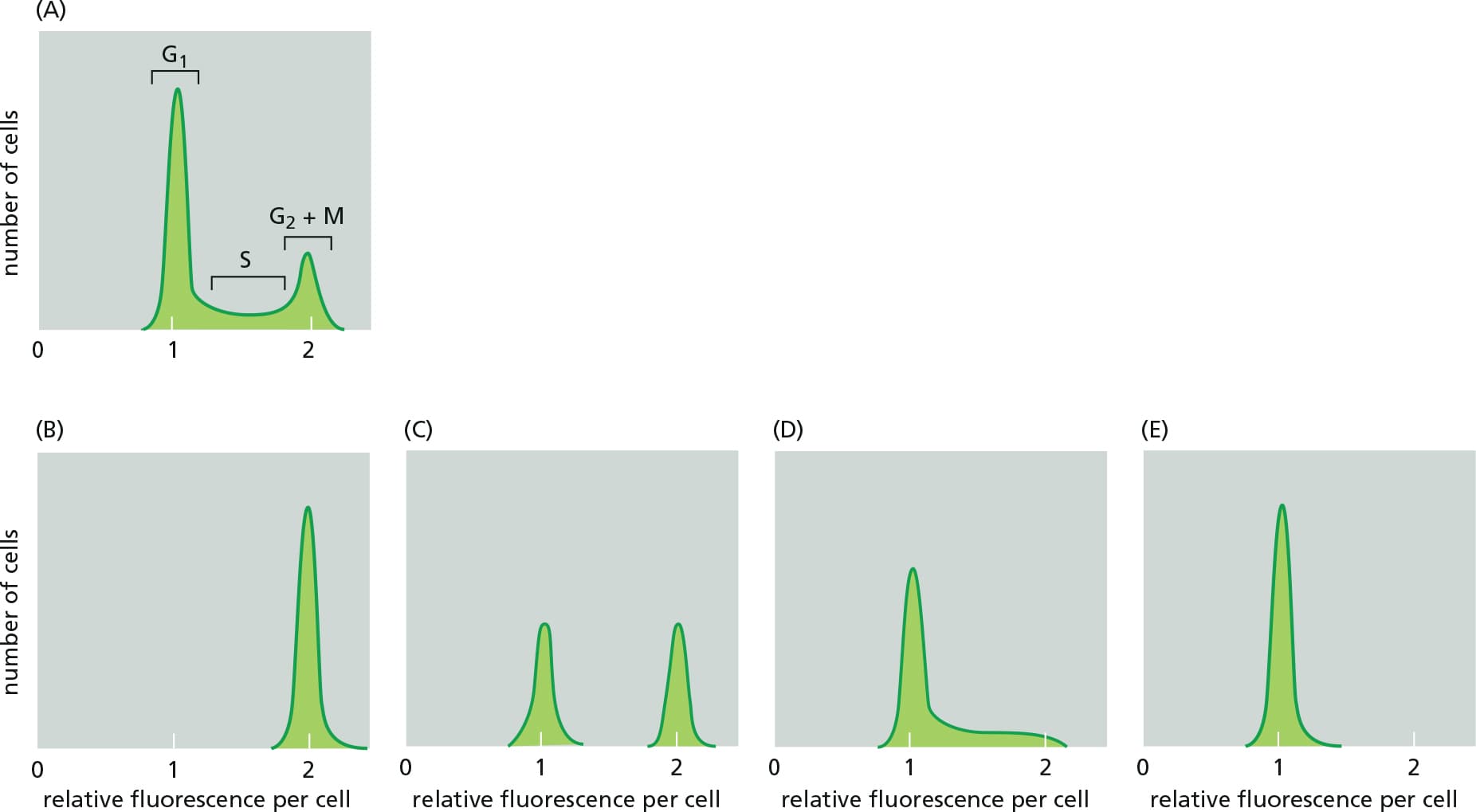
To a growing cell culture, you add a fluorescent dye that binds to DNA, and then you analyze the cells with a cell sorter, which measures the fluorescence of each cell. The output of the sorter is shown in the figure Part A, with the phases of the cell cycle indicated.Which one of the distributions shown in Parts B through E would you expect if you grew the cells in the presence of an inhibitor of S phase?
Not all cells undergo the conventional four-phase cell cycle. After the fertilization of the eggs of free-living aquatic organisms such as sea urchins, cell division proceeds very rapidly, reducing the very large single-cell egg into numerous normal-size cells. Which one of the following modified cell cycles best describes the early cell divisions in sea urchin embryos?
Although the lengths of all phases of the cell cycle are somewhat variable, by far the greatest variation occurs in the duration of G1.
Which one of the following definitions of the cell cycle is correct?
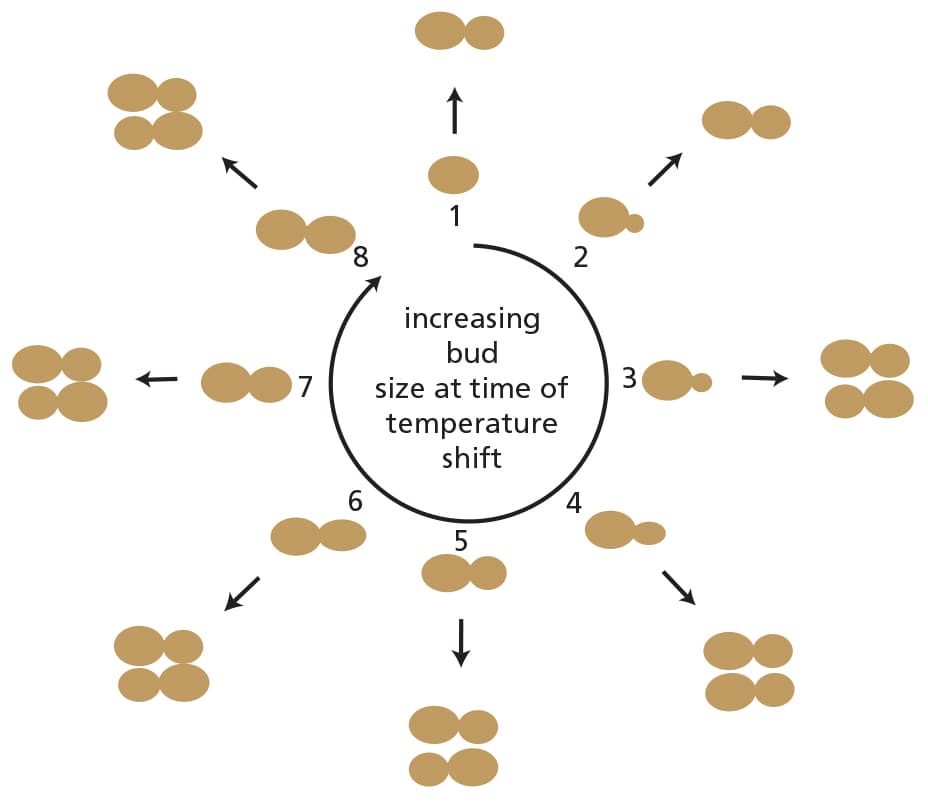
At the restrictive temperature, a particular temperature-sensitive mutant of budding yeast halts its progression through the cell cycle at a point when it has developed a large bud. To determine when in the cell cycle the protein made from the temperature-sensitive gene functions—its execution point—you use a video microscope with a heated stage that allows you to switch to the restrictive temperature at any point in the cell cycle. The effects of raising the temperature when cells are at various points during the cell cycle are shown in the figure, where cells on the inner ring are arranged by bud size, which corresponds to their position in the cell cycle. After 6 hours at the restrictive temperature, they have given rise to the cells shown on the outer ring. No further growth or division occurs.Where in the cell cycle is the execution point? Does it correspond to the time at which the cell cycle is arrested in the mutant?
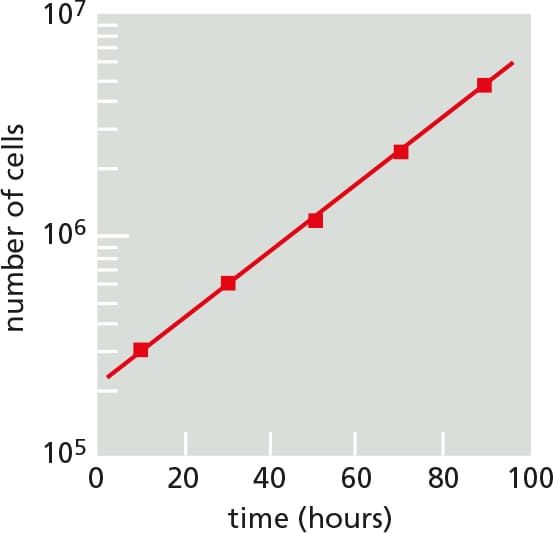
The average length of the cell cycle can be determined from the doubling time of an exponentially proliferating cell population. The figure plots the number of cells on a logarithmic scale against the time in hours. What is the overall length of the cell cycle in this culture?
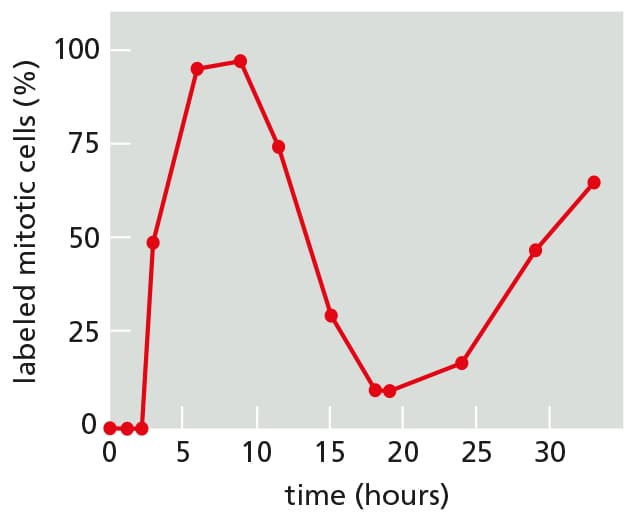
Exponentially growing cells were labeled by a brief exposure to radioactive thymidine, which was incorporated into DNA only in cells that were in S phase during the pulse. Cells in mitosis were then identified by their condensed chromosomes and the fraction that contained radioactive DNA was recorded as a function of time (see the figure).Why did no mitotic cells contain radioactivity for the first two hours or so?
One way to estimate the length of the cell cycle is to measure the fraction of the population that is undergoing mitosis (the mitotic index). You examine liver slices from an adult mouse, count 25,000 cells, and find 3 that are undergoing mitosis. Assuming that M phase lasts 30 minutes, what is the average length of the cell cycle in the liver?
The origin recognition complex (ORC), Cdc6, and Cdt1 load Mcm helicases at origins of replication during G1 phase. S-Cdk then triggers replication and prevents re-replication. But some origins fire early in S phase and some much later. How is it possible for S-Cdk to prevent re-replication at all these origins?
What is the term for the stage of mitosis in which the spindle poles move apart?
Each of the following steps in telophase is critical for the completion of mitosis EXCEPT:
Mitogens stimulate cell division, whereas growth factors stimulate cell growth.
What is the term for the enzyme that has a cysteine at its active site and cleaves its target proteins at specific aspartic acids?
The caspase-initiated proteolytic cascade is destructive and self-amplifying, but it can be reversed if it hasn’t proceeded too far.
The electron micrographs in the figure show one cell that died by apoptosis and another cell that died by necrosis. Which one of the following statements correctly distinguishes between the necrotic cell and the apoptotic cell?
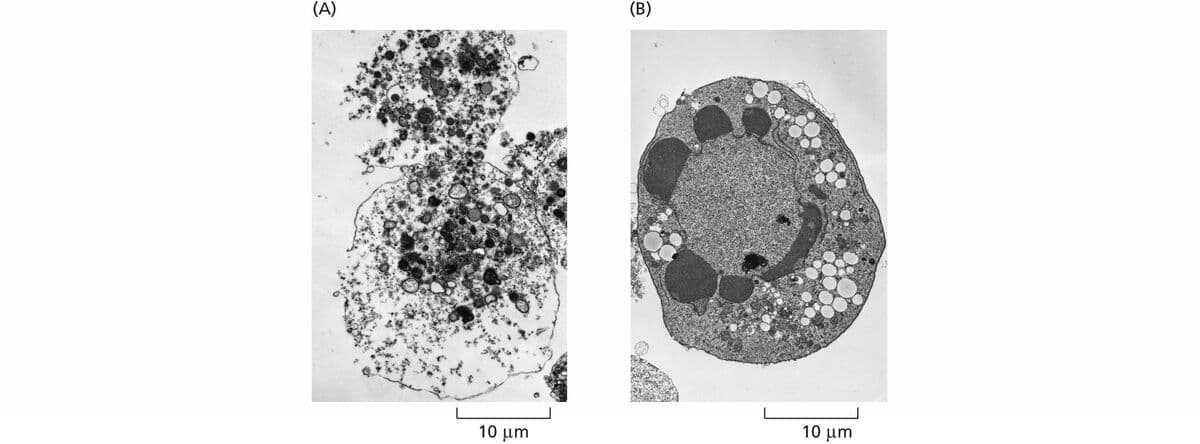
In apoptosis, the cell destroys itself from within and avoids spilling its contents outside the cell. What might be the consequences if apoptosis were not achieved in so neat and orderly a fashion?
What is the term for the form of cell death that leads to fragmentation of the DNA, shrinkage of the cytoplasm, membrane changes, and cell death, without lysis or damage to neighboring cells?
Early studies of apoptosis discovered that addition of dATP to a protein extract made from non-apoptotic human cells triggered the initial events of apoptosis, including activation of a key caspase. To determine how the apoptotic events were initiated, the scientists fractionated the extract on an ion-exchange column, which separated proteins that bound to the column from those that flowed through it. Neither the bound nor the free fraction alone was able to activate caspase in response to dATP; however, when the fractions were combined in the presence of dATP, they initiated apoptotic events. Purification of the activity in the bound fraction yielded a single protein that was found to be cytochrome c, providing the first evidence that cytochrome c controls apoptosis. Purification of the activity in the unbound fraction also yielded a single protein. The two purified proteins in the presence of dATP were sufficient to initiate apoptotic events.Which one of the following hypotheses offers the best explanation for the role of the protein in the unbound fraction?
Which of the following statements about the mechanism of action of survival factors are correct?
I. Some survival factors stimulate the synthesis of anti-apoptotic Bcl2 family proteins.
II. Some survival factors act by stimulating MOMP (mitochondrial outer membrane permeabilization.
III. Some survival factors inhibit the function of pro-apoptotic BH3-only proteins.IV Some survival factor receptors stimulate apoptosis when the survival factor is not bound.
In apoptotic cells, which one the following phospholipids flips from the inner leaflet of the lipid bilayer of the plasma membrane to the outer leaflet and serves as the eat-me signal for the apoptotic cell’s phagocytosis by neighboring cells?
Although the apoptotic cell and its fragments often break up and release their contents, the debris are efficiently cleaned up by healthy neighboring cells.
In about what fraction of all human cancers is the gene encoding the tumor suppressor protein p53 mutated, rendering it incapable of promoting apoptosis?
What is the term for the apoptotic program that depends on the release into the cytosol of proteins from the mitochondrial intermembrane space?
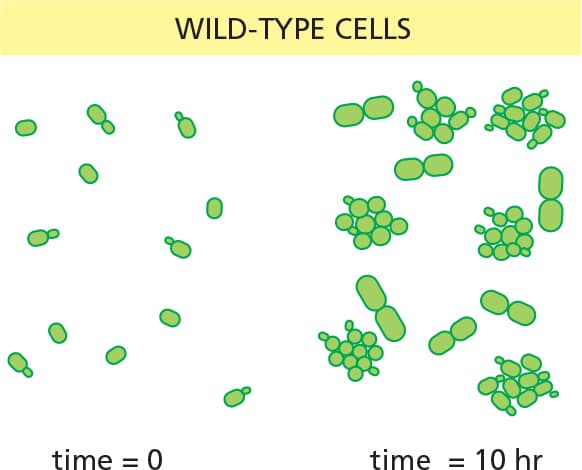
Using an agar-coated microscope slide, it is possible to follow the progress of individual yeast cells through the cell cycle. Yeast cells form a small bud when they enter the cycle, and the bud increases in size as the cells move through the cycle, until they divide into daughter cells. When exposed to x-rays at a level sufficient to cause chromosome breaks in all the cells, almost all wild-type cells arrested temporarily at the large-bud stage, but about half the cells formed small viable colonies after 10 hours (see the figure).In which stage of the cell cycle were the wild-type cells that did not form viable colonies when they were irradiated?
What is the general term for an extracellular substance that stimulates cell division?
What is the name of the final stage of mitosis in which the two sets of separated chromosomes decondense and become enclosed by nuclear envelopes?
To be fully active, Cdks require a cyclin subunit, an activating phosphorylation by Cdk-activating kinase (CAK), and the proper action of several other factors. Which one of the following combinations of functional states for Cdk inhibitor proteins (CKIs), the protein kinase Wee1, and the protein phosphatase Cdc25 is necessary to fully activate cyclin–Cdk?
What is the term for the complex of proteins that holds sister chromatids together along their length until they separate at mitosis?
G1-Cdk promotes synthesis of which of the following cyclins?
I. G1/S-cyclin
II. S-cyclin
III. M-cyclin