Loading...


Cell Bio Week 12
Quiz by Haniya Hopson
Tag the questions with any skills you have. Your dashboard will track each student's mastery of each skill.
What is the term for the short-range cell–cell communication via secreted local mediators that act on cells in their immediate environment?
There is no fundamental chemical distinction between signaling molecules that bind to cell-surface receptors and those that bind to intracellular receptors.
Cell-surface receptor proteins act as signal transducers by converting an extracellular ligand-binding event into intracellular signals that alter the behavior of the target cells.
Working out the order in which the individual components in a signaling pathway act is an essential step in defining the pathway. Imagine that two protein kinases, PK1 and PK2, act sequentially in a kinase cascade that activates a set of target proteins bringing about a cellular response. When either kinase is completely inactivated, cells do not respond to the normal extracellular signal. By contrast, cells containing a mutant form of PK1 that is permanently active respond even in the absence of an extracellular signal. Cells that contain both an inactivated PK2 and a permanently active PK1 respond in the absence of a signal.Given these data, what is the order of action of PK1 and PK2? What outcome would you predict for a doubly mutant cell line with an activating mutation in PK2 and an inactivating mutation in PK1?
What is the term for the protein that organizes groups of interacting intracellular signaling proteins into signaling complexes?
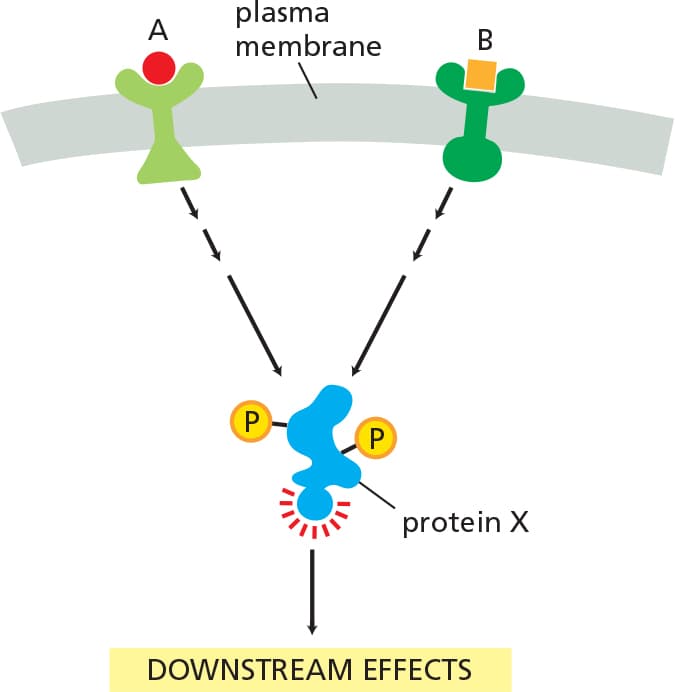
The integration of signals from more than one pathway can be performed by intracellular signaling proteins via several different mechanisms. As shown in the figure, the pathways controlled by signals A and B interact at the internal protein X, which must acquire two phosphates in order to transmit the signal to downstream targets. Consider the three possible mechanisms for integration described below.I Pathway A adds one phosphate; pathway B adds the other phosphate.II Either pathway A or pathway B can add both phosphates.III Pathway A adds both phosphates; pathway B removes one phosphate.Which of these mechanisms would transmit a downstream signal if signals A and B were both present?
What is the term for the cell–cell communication in which the signal molecule remains bound to the signaling cell and only influences cells that physically touch it?
What is the general term for a protein that binds a specific extracellular molecule and initiates a response in the cell?
Two main classes of molecular switches involve changes in phosphorylation state or changes in guanine nucleotide binding. Which of the following statements about these molecular switches are true?I In phosphorylation, protein kinases always turn proteins on, whereas protein phosphatases always turn proteins off.II In guanine nucleotide binding, guanine nucleotide exchange factors (GEFs) always turn proteins on, whereas GTPase-activating proteins (GAPs) always turn proteins off.
What is the term for the protein that binds to a GTP-binding protein and stimulates the hydrolysis of its bound GTP to GDP, converting the GTP-binding protein to its “off” state?
What is the name of the protein that binds to a GTP-binding protein and activates it by stimulating release of tightly bound GDP, thereby allowing it to bind GTP?
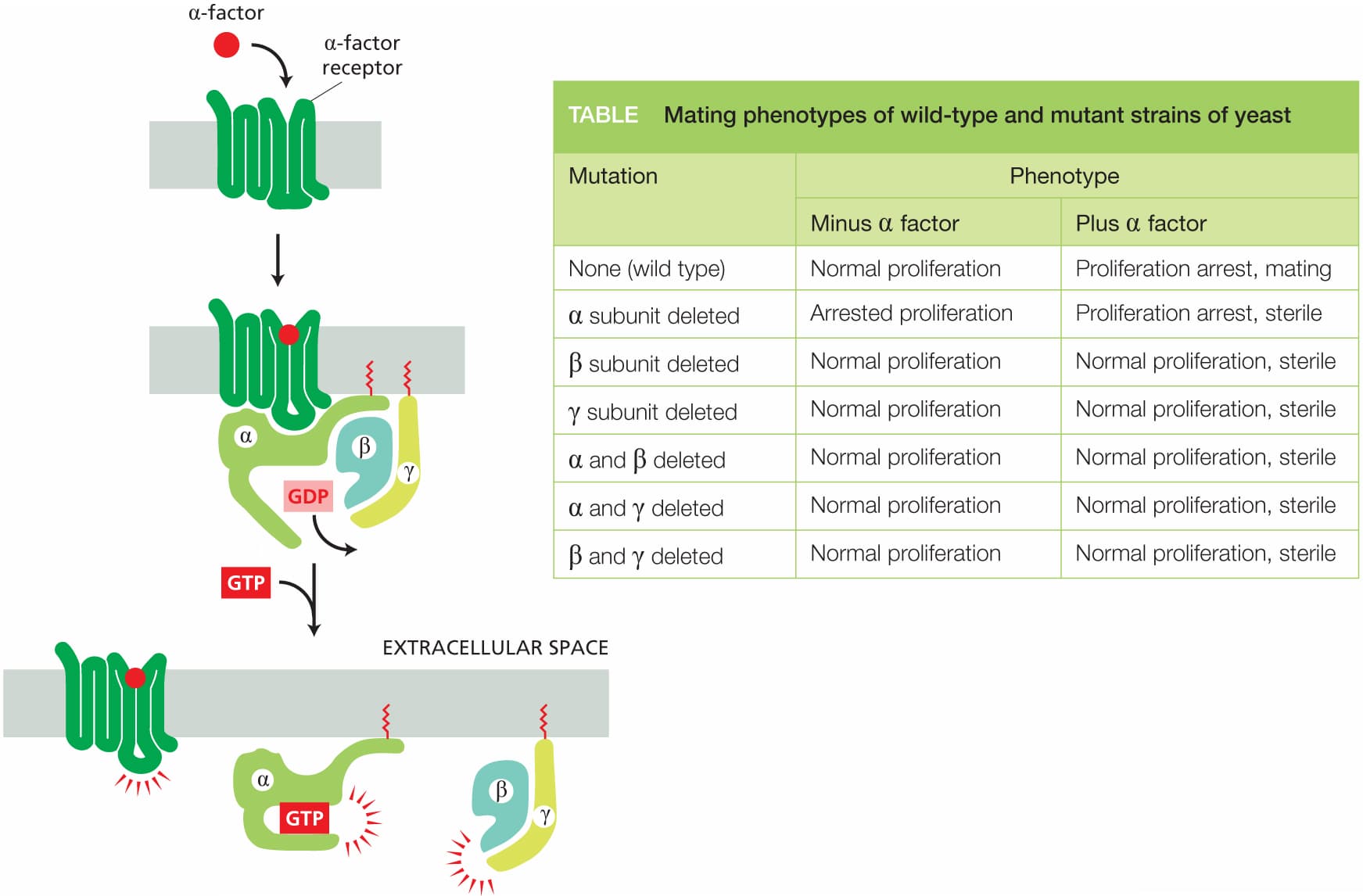
The mating behavior of yeast depends on signaling peptides termed pheromones that bind to pheromone GPCRs (see the figure). When the α-factor pheromone binds to a wild-type yeast cell, it blocks cell-cycle progression, arresting proliferation until a mating partner is found. Yeast mutants with defects in one or more of the components of the G protein have characteristic phenotypes in the absence and in the presence of the α-factor pheromone (see the table). Strains with defects in any of these genes cannot undergo the mating response and are therefore termed sterile.Based on this information, predict the proliferation and mating phenotypes in the presence of the α-factor pheromone of a strain in which the α subunit can bind GTP but cannot hydrolyze it.
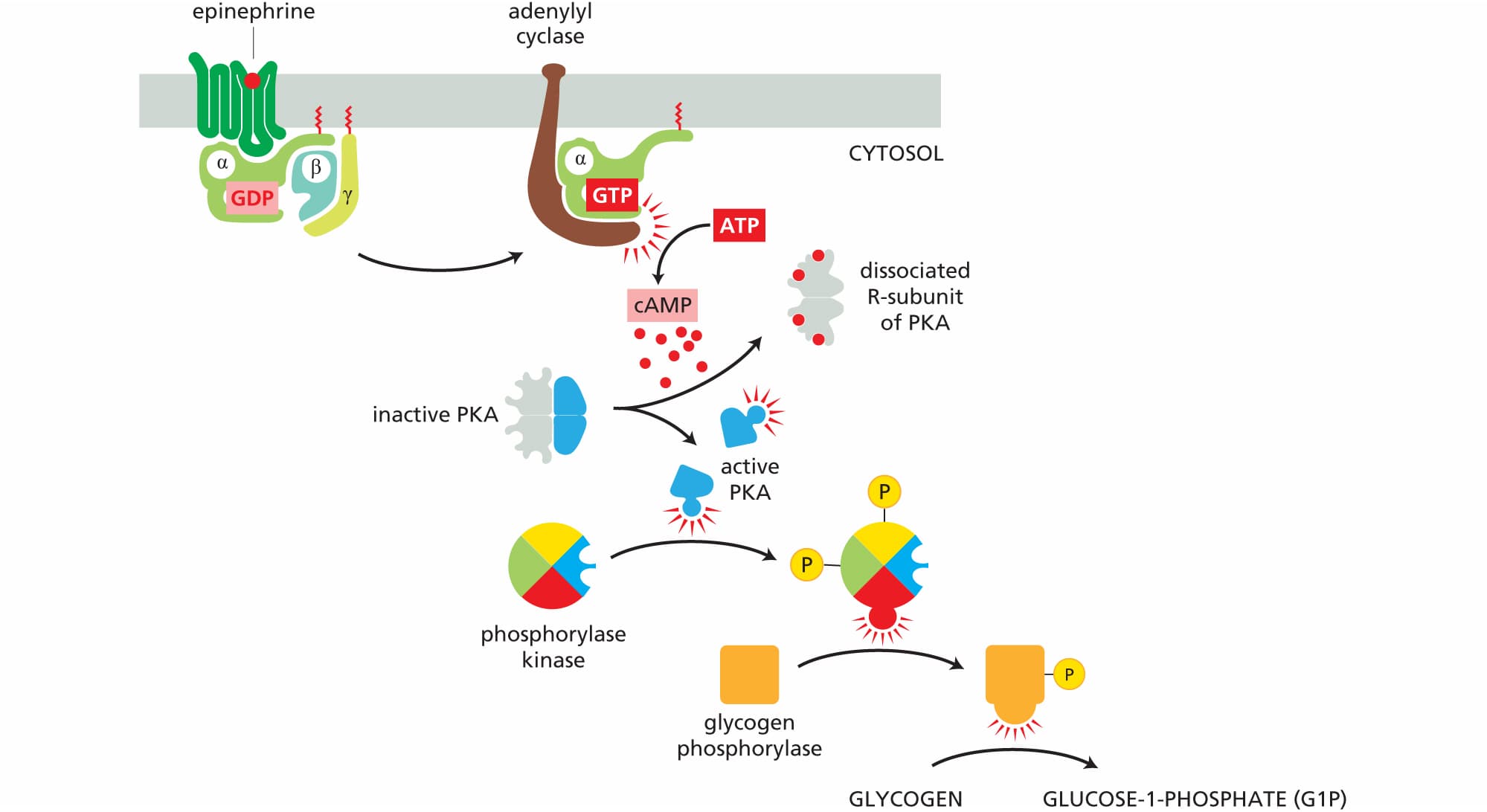
When epinephrine binds to its receptors on the surface of a muscle cell, it activates a G protein, initiating a signaling pathway that results in breakdown of muscle glycogen to produce glucose to meet the cell’s anticipated energy needs. Consider how glycogen breakdown would be affected if muscle cells were injected with a nonhydrolyzable analog of GTP, which can’t be converted to GDP.What would happen if the cells were briefly exposed to epinephrine just after they were injected with the nonhydrolyzable GTP analog?
GPCRs activate G proteins by reducing the strength of GDP binding, allowing GDP to dissociate and GTP, which is present at much higher concentrations, to bind. How would the activity of a G protein be affected by a mutation that caused its affinity for GDP to be reduced without significantly changing its affinity for GTP?
What is the term for the signaling protein composed of multiple subunits, one of which is activated by the binding of GTP, that links receptors to enzymes or ion channels?
During a marathon, runners draw heavily on their internal reserves of glycogen (carbohydrates) and triglycerides (fat) to fuel muscle contraction. Initially, energy is derived mostly from carbohydrates, with increasing amounts of fat being used as the race progresses.If runners use up their muscle glycogen reserves before they finish the race, they hit what is known as “the wall,” a point of diminished performance that arises because fatty acids from triglyceride breakdown cannot be delivered to the muscles quickly enough to sustain maximum effort. One trick that marathon runners use to avoid the wall is to drink a cup of strong black coffee an hour or so before the race begins. Coffee contains caffeine, which is an inhibitor of cyclic AMP phosphodiesterase.How would inhibition of cAMP phosphodiesterase help runners avoid the wall?
What is “cyclic” about cyclic AMP?
A critical feature of all signaling cascades is that they must be turned off rapidly when the extracellular signal is removed. Examine the signaling cascade for activation of glycogen breakdown to glucose 1-phosphate (G1P) by epinephrine in muscle cells (see the figure). Which one of the following statements correctly describes how a component of this signaling pathway is returned to its inactive state when epinephrine is removed?
What is the name of the enzyme that phosphorylates target proteins in response to a rise in intracellular cyclic AMP?
Which of the following alterations to the signaling pathway would lead to increased transcription by the CREB protein?
Which of the following would increase phosphorylation of CREB by PKA?
What is the name of the second messenger that is released from a phospholipid in the plasma membrane and diffuses to the ER, where it opens Ca2+-release channels?
Which one of the following proteins is an enzyme that is bound to the cytoplasmic surface of the plasma membrane and converts membrane PI(4,5)P2 to diacylglycerol and IP3?
Why do you suppose cells use Ca2+ (intracellular concentration 10–7 M) for signaling rather than the more abundant Na+ (intracellular concentration 10–3 M)?
What is the name of the ubiquitous calcium-binding protein whose interactions with other proteins are governed by changes in intracellular Ca2+ concentration?
What is the name for the cell-surface receptors that, when activated by ligand binding, add phosphates from ATP to tyrosine side chains in their own cytoplasmic domains?
A single amino acid change in Ras eliminates its ability to hydrolyze GTP, even in the presence of a GTPase-activating protein (GAP). Roughly 30% of human cancers have this change in Ras. You have just identified a small molecule that prevents the dimerization of the receptor tyrosine kinase (RTK) that signals via Ras. Would you expect this molecule to be effective in the treatment of cancers that express this common, mutant form of Ras? Why or why not?
The Ras protein functions as a molecular switch that is turned on by a guanine nucleotide exchange factor (GEF) that causes it to bind GTP. A GTPase-activating protein (GAP) turns the switch off by inducing Ras to hydrolyze its bound GTP to GDP much more rapidly than in the absence of the GAP. Thus, Ras works like a light switch that one person turns on and another turns off.Which one of the following abnormalities in Ras activity (in the presence or absence of an extracellular signal) would you expect to find in a cell line that lacks the Ras-specific GAP?
In general, the intracellular signaling pathways triggered by receptor tyrosine kinases (RTKs) and G-protein coupled receptors (GPCRs) do not overlap or interact.
The steroid hormones cortisol, estradiol, and testosterone are all derived from cholesterol by modifications that introduce polar groups such as –OH and =O (see the figure). If cholesterol itself was not a normal component of cell membranes, do you suppose it could be used effectively as a hormone, provided that an appropriate intracellular receptor was available? Why or why not?
