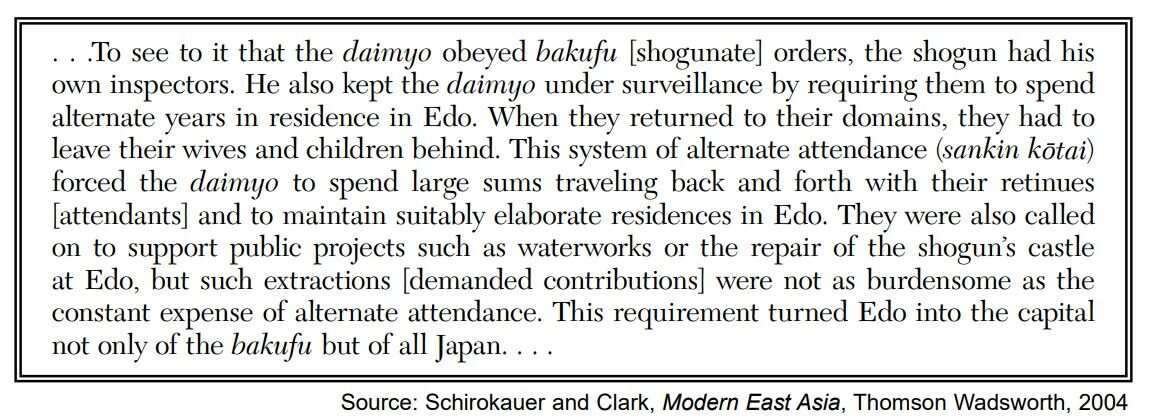
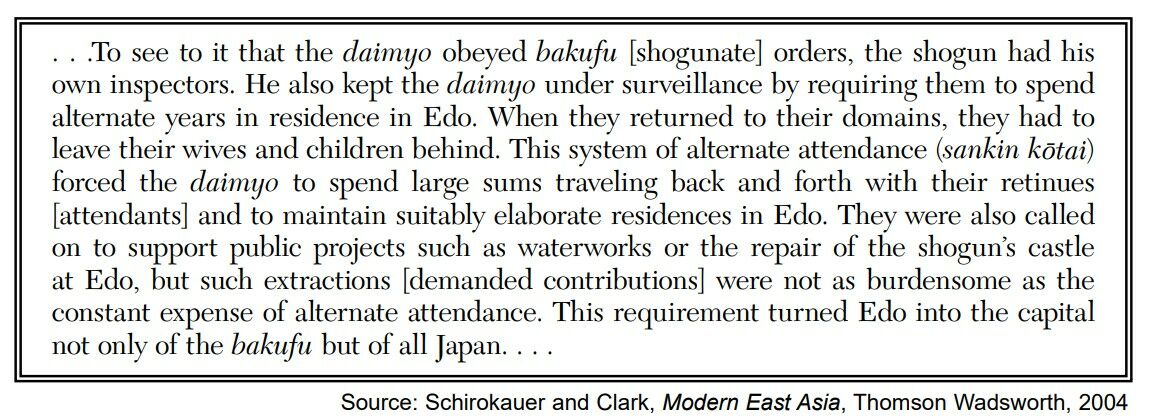
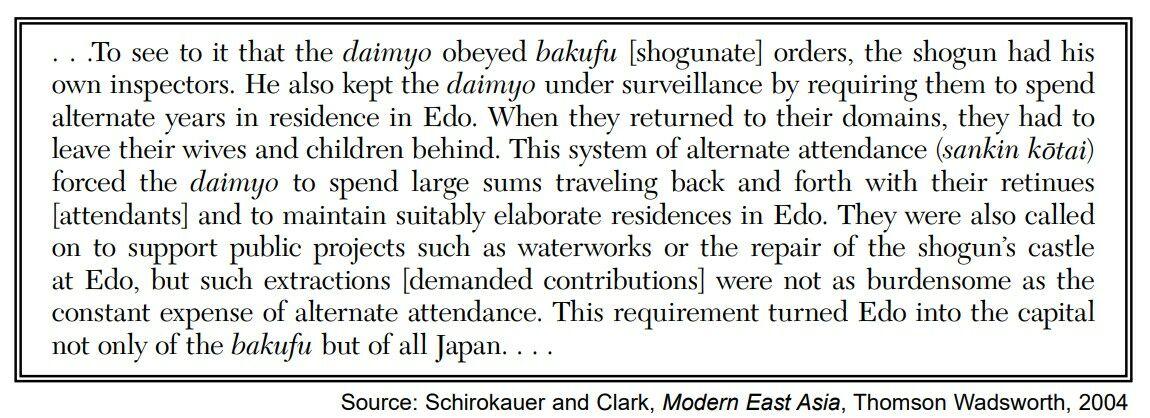
Powerful Eurasian states and empires faced and responded to challenges ca. 1750. Students will compare and contrast the Mughal Empire and the Ottoman Empire in 1750 in terms of religious and ethnic tolerance, political organization, and commercial activity. Students will examine efforts to unify, stabilize, and centralize Japan under the rule of the Tokugawa Shogunate. Students will compare and contrast the Tokugawa Shogunate in Japan with France under the rule of the Bourbon Dynasty, looking at the role of Edo and Paris/Versailles, attempts to control the daimyo and nobles, and the development of bureaucracies.
Perceptions of outsiders and interactions with them varied across Eurasia. Students will compare and contrast the Tokugawa and Mughal responses to outsiders, with attention to the impacts of those decisions. Students will create a world map showing the extent of European maritime empires, the Russian Empire, the Ottoman Empire, Mughal Empire, China under the Qing Dynasty, Japan under the Tokugawa Shogunate, Ashanti, Benin, and Dahomey ca. 1750. Students will compare the size of these states, empires, and kingdoms relative to the power they wielded in their regions and in the world.
Enlightenment thinkers developed political philosophies based on natural laws, which included the concepts of social contract, consent of the governed, and the rights of citizens. Students will examine at least three Enlightenment thinkers, including John Locke, Baron de Montesquieu, and Jean-Jacques Rousseau, and key ideas from their written works.
Individuals used Enlightenment ideals to challenge traditional beliefs and secure people's rights in reform movements, such as women's rights and abolition; some leaders may be considered enlightened despots. Students will explore the influence of Enlightenment ideals on issues of gender and abolition by examining the ideas of individuals such as Mary Wollstonecraft and William Wilberforce. Students will examine enlightened despots including Catherine the Great.
Agricultural innovations and technologies enabled people to alter their environment, allowing them to increase and support farming on a large scale. Students will examine the agricultural revolution in Great Britain.
European industrialized states and Japan sought to play a dominant role in the world and to control natural resources for political, economic, and cultural reasons. Students will explore imperialism from a variety of perspectives such as those of missionaries, indigenous peoples, women, merchants/business people, and government officials. Students will trace how imperial powers politically and economically controlled territories and people, including direct and indirect rule in Africa (South Africa, Congo, and one other territory), India, Indochina, and spheres of influence in China.
International competition, fueled by nationalism, imperialism, and militarism along with shifts in the balance of power and alliances, led to world wars. Students will compare and contrast long- and short-term causes and effects of World War I and World War II.
Technological developments increased the extent of damage and casualties in both World War I and World War II. Students will compare and contrast the technologies utilized in both World War I and World War II, noting the human and environmental devastation.
The devastation of the world wars and use of total war led people to explore ways to prevent future world wars. Students will examine international efforts to work together to build stability and peace, including Wilson's Fourteen Points, the Treaty of Versailles, the League of Nations, and the United Nations.
The Cold War originated from tensions near the end of World War II as plans for peace were made and implemented. The Cold War was characterized by competition for power and ideological differences between the United States and the Soviet Union. Students will compare and contrast how peace was conceived at Yalta and Potsdam with what happened in Europe in the four years after World War II (i.e., Soviet occupation of Eastern Europe, Truman Doctrine, Berlin blockade, NATO).
The Cold War was a period of confrontations and attempts at peaceful coexistence. Students will investigate the efforts to expand and contain communism in Cuba, Vietnam, and Afghanistan from multiple perspectives. Students will examine the new military alliances, nuclear proliferation, and the rise of the military-industrial complex. Students will examine the reasons countries such as Egypt and India chose nonalignment. Students will explore the era of détente from both American and Sovietperspectives.
Independence movements in India and Indochina developed in response to European control. Students will explore Gandhi's nonviolent nationalist movement and nationalist efforts led by the Muslim League aimed at the masses that resulted in a British-partitioned subcontinent. Students will compare and contrast the ideologies and methodologies of Gandhi and Ho Chi Minh as nationalist leaders.
African independence movements gained strength as European states struggled economically after World War II. European efforts to limit African nationalist movements were often unsuccessful. Students will explore at least two of these three African independence movements: Ghana, Algeria, Kenya.
Cultures and countries experience and view modernization differently. For some, it is a change from a traditional rural, agrarian condition to a secular, urban, industrial condition. Some see modernization as a potential threat and others as an opportunity to be met. Students will investigate the extent to which urbanization and industrialization have modified the roles of social institutions such as family, religion, education, and government by examining one case study in each of these regions: Africa (e.g., Zimbabwe, Kenya, Nigeria, Sierra Leone), Latin America (e.g., Brazil, Argentina, Chile, Mexico), and Asia (e.g., China, India, Indonesia, South Korea).
Tensions between agents of modernization and traditional cultures have resulted in ongoing debates within affected societies regarding social norms, gender roles, and the role of authorities and institutions. Students will investigate, compare, and contrast tensions between modernization and traditional culture in Turkey under the rule of Kemal Ataturk and in Iran under the Pahlavis and the Ayatollahs. Students will explore how changes in technology, such as communication and transportation, have affected interactions between people and those in authority (e.g., efforts to affect change in government policy, engage people in the political process including use of social media, control access to information, and use terrorism as a tactic).
Governments, groups, and individuals have responded in various ways to the human atrocities committed in the 20th and 21st centuries. Students will explore multinational treaties and international court systems that bind countries to adhere to international human rights. Students will explore international organizations that work to maintain peace, stability, and economic prosperity, and to protect nations and people from oppressive governments and political violence.
Globalization is contentious, supported by some and criticized by others. Students will compare and contrast arguments supporting and criticizing globalization by examining concerns including: free market, export-oriented economies vs. localized, sustainable activities development of a mixed economy in China and China's role in the global economy multinational corporations and cartels (e.g., Organization of Petroleum Exporting Countries) roles of the World Trade Organization, the World Bank, the International Monetary Fund, and microfinance institutions economic growth and economic downturns (e.g., recession, depression) on a national and a global scale economic development and inequality (e.g., access to water, food, education, health care, energy) migration and labor ethnic diversity vs. homogenization (e.g., shopping malls, fast food franchises, language, popular culture).
Track each student's skills and progress in your Mastery dashboards