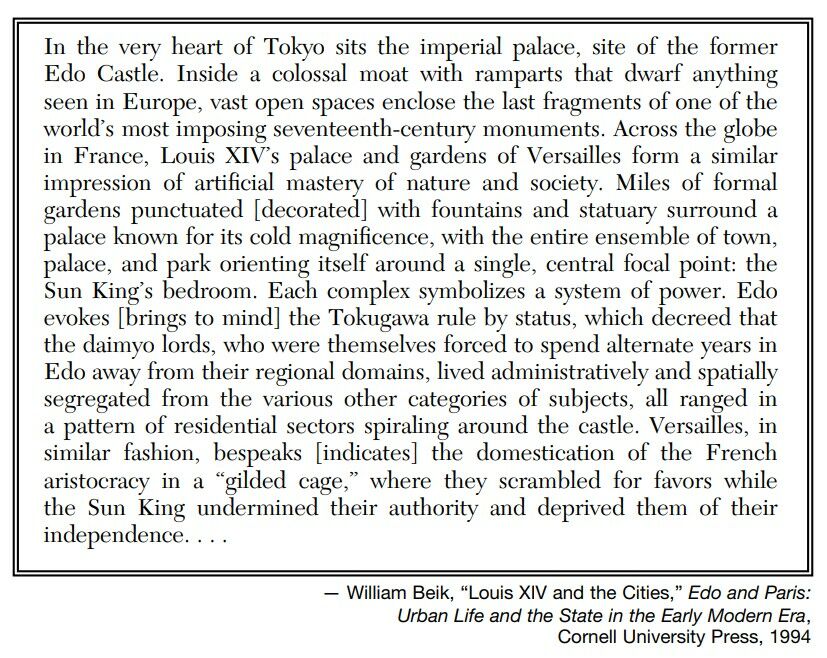
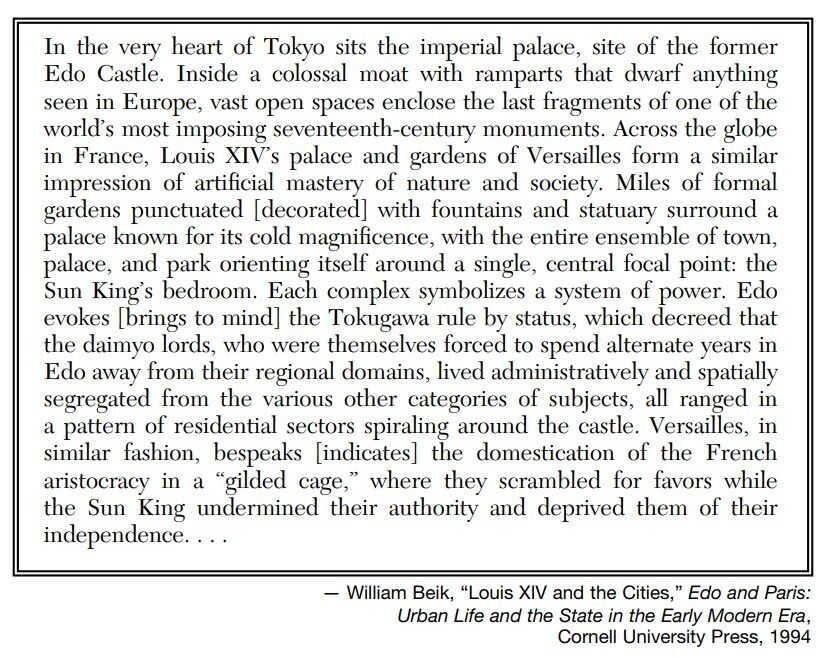
Powerful Eurasian states and empires faced and responded to challenges ca. 1750. Students will compare and contrast the Mughal Empire and the Ottoman Empire in 1750 in terms of religious and ethnic tolerance, political organization, and commercial activity. Students will examine efforts to unify, stabilize, and centralize Japan under the rule of the Tokugawa Shogunate. Students will compare and contrast the Tokugawa Shogunate in Japan with France under the rule of the Bourbon Dynasty, looking at the role of Edo and Paris/Versailles, attempts to control the daimyo and nobles, and the development of bureaucracies.
Individuals and groups drew upon principles of the Enlightenment to spread rebellions and call for revolutions in France and the Americas. Students will examine evidence related to the preconditions of the French Revolution and the course of the revolution, noting the roles of Olympe de Gouges, Maximilien Robespierre, and Napoleon Bonaparte. Students will examine the evidence related to the impacts of the French Revolution on resistance and revolutionary movements, noting the roles of Toussaint L'Ouverture and Simon Bolivar.
Shifts in population from rural to urban areas led to social changes in class structure, family structure, and the daily lives of people. Students will investigate the social, political, and economic impacts of industrialization in Victorian England and Meiji Japan and compare and contrast them.
Social and political reform, as well as new ideologies, developed in response to industrial growth. Students will investigate suffrage, education, and labor reforms, as well as ideologies such as Marxism, that were intended to transform society. Students will examine the Irish potato famine within the context of the British agricultural revolution and Industrial Revolution.
Technological developments increased the extent of damage and casualties in both World War I and World War II. Students will compare and contrast the technologies utilized in both World War I and World War II, noting the human and environmental devastation.
Nationalism and ideology played a significant role in shaping the period between the world wars. Students will examine the Russian Revolution and the development of Soviet ideology and nationalism under Lenin and Stalin. Students will examine the role of nationalism and the development of the National Socialist state under Hitler in Germany. Students will examine the role of nationalism and militarism in Japan. Students will investigate the causes of the Great Depression and its influence on the rise of totalitarian dictators and determine the common characteristics of these dictators.
The Cold War was a period of confrontations and attempts at peaceful coexistence. Students will investigate the efforts to expand and contain communism in Cuba, Vietnam, and Afghanistan from multiple perspectives. Students will examine the new military alliances, nuclear proliferation, and the rise of the military-industrial complex. Students will examine the reasons countries such as Egypt and India chose nonalignment. Students will explore the era of détente from both American and Sovietperspectives.
Independence movements in India and Indochina developed in response to European control. Students will explore Gandhi's nonviolent nationalist movement and nationalist efforts led by the Muslim League aimed at the masses that resulted in a British-partitioned subcontinent. Students will compare and contrast the ideologies and methodologies of Gandhi and Ho Chi Minh as nationalist leaders.
Nationalism in the Middle East was often influenced by factors such as religious beliefs and secularism. Students will investigate Zionism, the mandates created at the end of World War I, and Arab nationalism. Students will examine the creation of the State of Israel and the Arab-Israeli conflict.
Cultures and countries experience and view modernization differently. For some, it is a change from a traditional rural, agrarian condition to a secular, urban, industrial condition. Some see modernization as a potential threat and others as an opportunity to be met. Students will investigate the extent to which urbanization and industrialization have modified the roles of social institutions such as family, religion, education, and government by examining one case study in each of these regions: Africa (e.g., Zimbabwe, Kenya, Nigeria, Sierra Leone), Latin America (e.g., Brazil, Argentina, Chile, Mexico), and Asia (e.g., China, India, Indonesia, South Korea).
The end of the Cold War and the collapse of the communist bloc in Europe had a global impact. Students will investigate the political reforms of glasnost and economic reforms of perestroika. Students will examine the impacts of those reforms within the Soviet Union, on the Soviet communist bloc, and in the world.
Globalization is contentious, supported by some and criticized by others. Students will compare and contrast arguments supporting and criticizing globalization by examining concerns including: free market, export-oriented economies vs. localized, sustainable activities development of a mixed economy in China and China's role in the global economy multinational corporations and cartels (e.g., Organization of Petroleum Exporting Countries) roles of the World Trade Organization, the World Bank, the International Monetary Fund, and microfinance institutions economic growth and economic downturns (e.g., recession, depression) on a national and a global scale economic development and inequality (e.g., access to water, food, education, health care, energy) migration and labor ethnic diversity vs. homogenization (e.g., shopping malls, fast food franchises, language, popular culture).
Governments, groups, and individuals have responded in various ways to the human atrocities committed in the 20th and 21st centuries. Students will explore multinational treaties and international court systems that bind countries to adhere to international human rights. Students will explore international organizations that work to maintain peace, stability, and economic prosperity, and to protect nations and people from oppressive governments and political violence.
Track each student's skills and progress in your Mastery dashboards