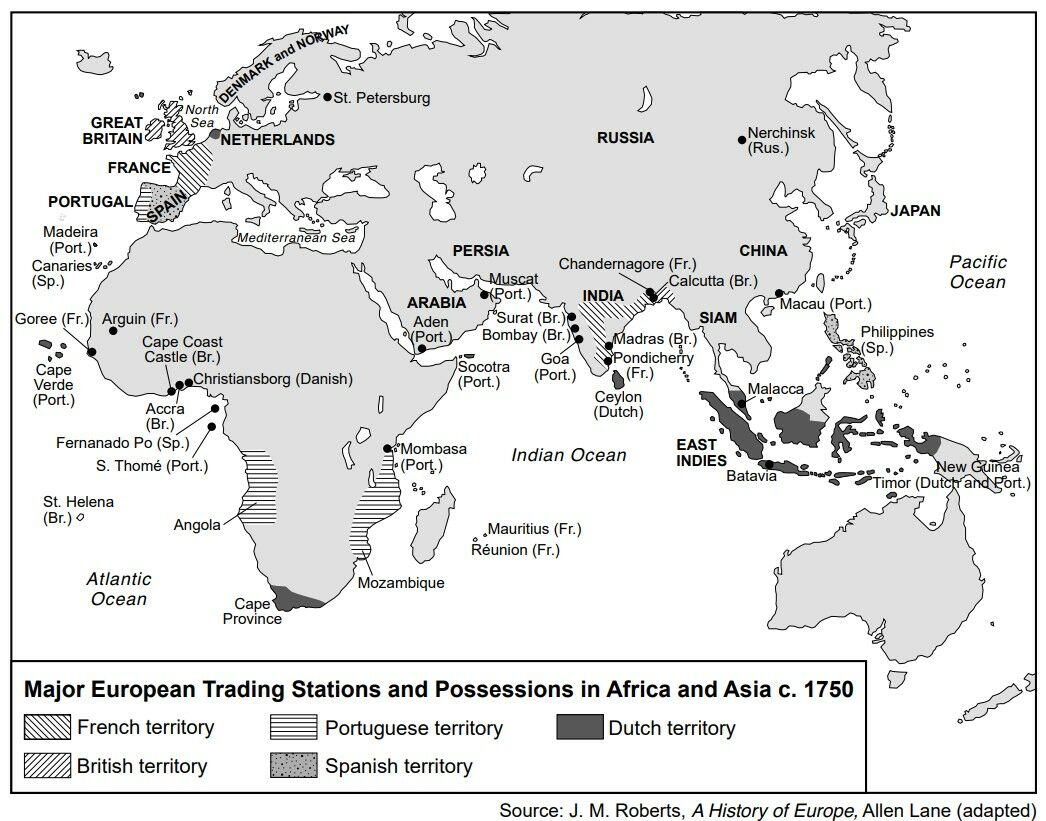
Perceptions of outsiders and interactions with them varied across Eurasia. Students will compare and contrast the Tokugawa and Mughal responses to outsiders, with attention to the impacts of those decisions. Students will create a world map showing the extent of European maritime empires, the Russian Empire, the Ottoman Empire, Mughal Empire, China under the Qing Dynasty, Japan under the Tokugawa Shogunate, Ashanti, Benin, and Dahomey ca. 1750. Students will compare the size of these states, empires, and kingdoms relative to the power they wielded in their regions and in the world.
Individuals used Enlightenment ideals to challenge traditional beliefs and secure people's rights in reform movements, such as women's rights and abolition; some leaders may be considered enlightened despots. Students will explore the influence of Enlightenment ideals on issues of gender and abolition by examining the ideas of individuals such as Mary Wollstonecraft and William Wilberforce. Students will examine enlightened despots including Catherine the Great.
Enlightenment thinkers developed political philosophies based on natural laws, which included the concepts of social contract, consent of the governed, and the rights of citizens. Students will examine at least three Enlightenment thinkers, including John Locke, Baron de Montesquieu, and Jean-Jacques Rousseau, and key ideas from their written works.
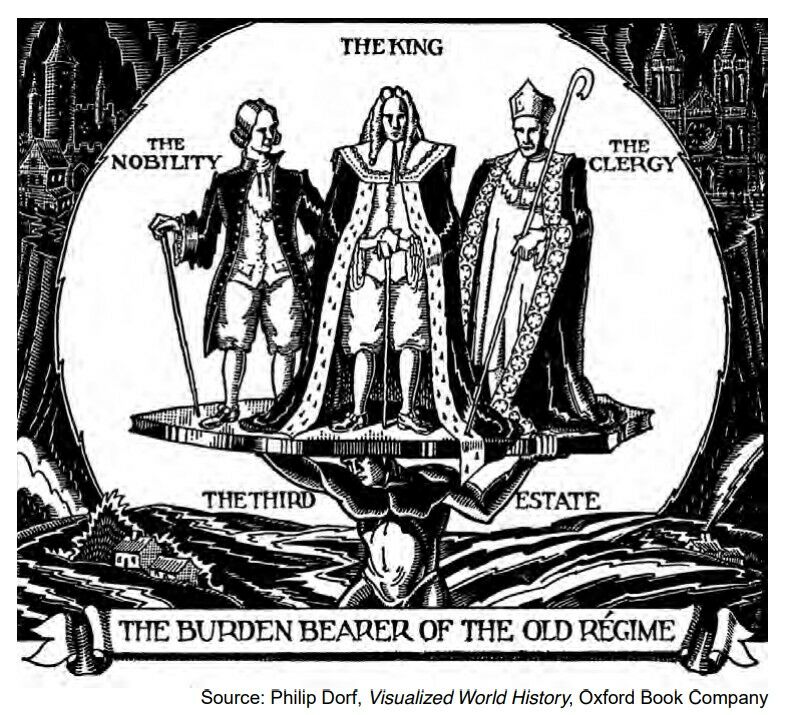
Individuals and groups drew upon principles of the Enlightenment to spread rebellions and call for revolutions in France and the Americas. Students will examine evidence related to the preconditions of the French Revolution and the course of the revolution, noting the roles of Olympe de Gouges, Maximilien Robespierre, and Napoleon Bonaparte. Students will examine the evidence related to the impacts of the French Revolution on resistance and revolutionary movements, noting the roles of Toussaint L'Ouverture and Simon Bolivar.
Those who faced being colonized engaged in varying forms of resistance and adaptation to colonial rule with varying degrees of success. Students will investigate one example of resistance in Africa (Zulu, Ethiopia, or Southern Egypt/Sudan) and one in China (Taiping Rebellion or Boxer Rebellion and the role of Empress Dowager CiXi). Students will investigate how Japan reacted to the threat of Western imperialism in Asia.
International competition, fueled by nationalism, imperialism, and militarism along with shifts in the balance of power and alliances, led to world wars. Students will compare and contrast long- and short-term causes and effects of World War I and World War II.
The Cold War was a period of confrontations and attempts at peaceful coexistence. Students will investigate the efforts to expand and contain communism in Cuba, Vietnam, and Afghanistan from multiple perspectives. Students will examine the new military alliances, nuclear proliferation, and the rise of the military-industrial complex. Students will examine the reasons countries such as Egypt and India chose nonalignment. Students will explore the era of détente from both American and Sovietperspectives.
African independence movements gained strength as European states struggled economically after World War II. European efforts to limit African nationalist movements were often unsuccessful. Students will explore at least two of these three African independence movements: Ghana, Algeria, Kenya.
Cultures and countries experience and view modernization differently. For some, it is a change from a traditional rural, agrarian condition to a secular, urban, industrial condition. Some see modernization as a potential threat and others as an opportunity to be met. Students will investigate the extent to which urbanization and industrialization have modified the roles of social institutions such as family, religion, education, and government by examining one case study in each of these regions: Africa (e.g., Zimbabwe, Kenya, Nigeria, Sierra Leone), Latin America (e.g., Brazil, Argentina, Chile, Mexico), and Asia (e.g., China, India, Indonesia, South Korea).
Globalization has created new possibilities for international cooperation and for international conflict. Students will examine the roles of the United Nations (UN), North Atlantic Treaty Organization (NATO), the European Union, nongovernmental organizations (NGOs), and efforts to build coalitions to promote international cooperation to address conflicts and issues. They will also examine the extent to which these efforts were successful. Students will investigate one organization and one international action that sought to provide solutions to environmental issues, including the Kyoto Protocol. Students will examine threats to global security, such as international trade in weapons (e.g., chemical, biological, and nuclear), nuclear proliferation, cyber war, and terrorism, including a discussion of the events of September 11, 2001.
Historical and contemporary violations of human rights can be evaluated, using the principles and articles established within the UN Universal Declaration of Human Rights. Students will examine the atrocities committed under Augusto Pinochet, Deng Xiaoping, and Slobodan Milosevic in light of the principles and articles within the UN Universal Declaration of Human Rights. Students will examine and analyze the roles of perpetrators and bystanders in human rights violations in Cambodia, Rwanda, and Darfur in light of the principles and articles within the UN Universal Declaration of Human Rights. Students will examine the policy of apartheid in South Africa and the growth of the anti apartheid movements, exploring Nelson Mandela?s role in these movements and in the post-apartheid period. Students will explore efforts to address human rights violations by individuals and groups, including the efforts of Mother Teresa, Aung San Suu Kyi, and the Mothers of the Plaza de Mayo.
Governments, groups, and individuals have responded in various ways to the human atrocities committed in the 20th and 21st centuries. Students will explore multinational treaties and international court systems that bind countries to adhere to international human rights. Students will explore international organizations that work to maintain peace, stability, and economic prosperity, and to protect nations and people from oppressive governments and political violence.
Track each student's skills and progress in your Mastery dashboards