Organisms & Environments
Quiz by Tyisha Smith
Feel free to use or edit a copy
includes Teacher and Student dashboards
Measure skillsfrom any curriculum
Tag the questions with any skills you have. Your dashboard will track each student's mastery of each skill.
- edit the questions
- save a copy for later
- start a class game
- automatically assign follow-up activities based on students’ scores
- assign as homework
- share a link with colleagues
- print as a bubble sheet
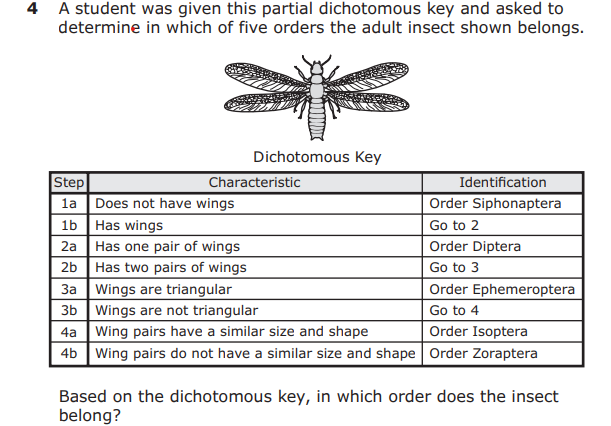
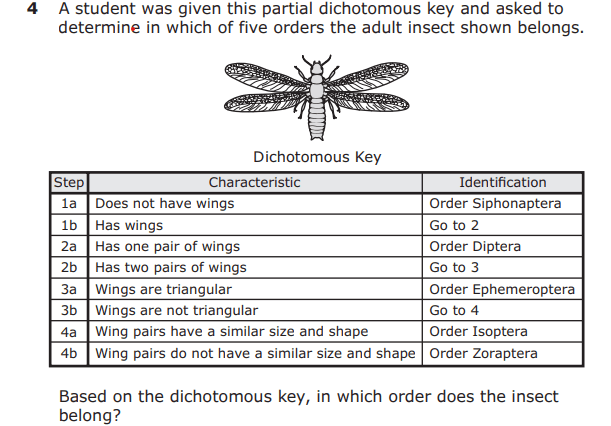
- Q1
Answer the question below:
Ephemeroptera
Diptera
Zoraptera
Isoptera
300s - Q2
What function do both cell membranes and cell walls perform?
Allowing water to move into and out of cells
Synthesizing genetic material
Producing energy for cellular processes
Directing the reproduction of the cell
300s - Q3
Two plant species that grow in the same area are shown.
Which statement best explains a difference between Plant 1 and Plant 2
Plant 1 obtains more water from the soil because of its root surface area and root depth.
Plant 1 obtains more sunlight because of its root surface area and root depth.
Plant 2 obtains more sunlight because of its root surface area and root depth.
Plant 2 obtains more water from the soil because of its root surface area and root depth.
300s - Q4
Which table explains the functions of the two body systems thatthe students investigated?
300s - Q5
Students observe an unknown species during a field study. They observe that the organism is multicellular, is autotrophic, and can reproduce both sexually and asexually.
Which kingdom does this organism most likely belong to?
Bacteria
Plantae
Animalia
Archaea
300s - Q6
Humans depend upon food that comes from the ocean. Some human activities negatively impact these food supplies.
Which statement provides the best evidence that human activities contribute to this impact?
Humans raise fish in a hatchery for commercial sale.
Human visitors to coral reef systems break corals growing on rocks
Humans construct artificial reefs to attract tourists
Humans catch marine fish at a faster rate than the fish are able to reproduce.
300s - Q7
Which of these is most likely observed in an area experiencing a long-term drought?
Trees with leaves without any hairlike structures will be more healthy than trees with leaves covered by hairlike structures.
Trees with broad leaves will be more healthy than trees with needlelike leaves.
Trees with broad leaves will be more healthy than trees with small, flat leaves.
Trees with leaves that have waxy coverings will be more healthy than trees without wax-covered leaves.
300s - Q8
According to this food web, which organisms would the bobcat and diamondback rattlesnake compete for if the mouse population and swamp rabbit population decreased?
Sparrow and Eastern cottontail rabbit
Raccoon and sparrow
Sparrow and seeds
Sparrow and Eastern cottontail rabbit
300s - Q9
Immediately after a forest fire, the primary consumers in the area will compete most for which biotic factor?
Oxygen
Space
Food
Sunlight
300s - Q10
Tiny organisms called Daphnia live in lakes and ponds where they consume algae. A lake with a stable population of algae and Daphnia was contaminated by pollution, resulting in the death of many algae.
Which graph shows the most likely trend in the Daphnia population in the lake shortly before and after the pollution event?
30s - Q11
A farmer digs a small pond in a pasture. The farmer adds young individuals from two species of algae-eating fish to the pond and plants some reeds around the edges of the pond. The farmer wants the pond to be a sustainable ecosystem.
Which of the following would be most helpful in increasing the pond ecosystem’s sustainability?
Introducing older fish of the same species into the population of algae-eating fish
Adding gravel between the water and where the reeds are planted
Having a greater diversity of living organisms in the pond
Decreasing the number of plant species around the edges of the pond
300s - Q12
Based on the organelles observed, the students determine that cell 2 is a plant cell because it has an organelle that —
stores water and nutrients
produces its own food
contains genetic information
allows water to enter and exit the cell
300s - Q13
Species Z can successfully share the same environment with the other plants shown because species Z absorbs water —
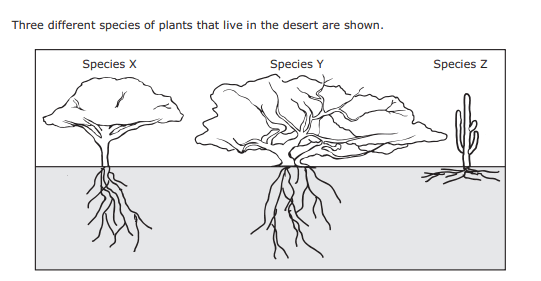
found deep underground, and species X absorbs water found deep underground
near the soil surface, and species Y absorbs water near the soil surface
found deep underground, and species X absorbs water near the soil surface
near the soil surface, and species Y absorbs water found deep underground
300s - Q14
Which statement best predicts the change in subsequent populations of these seed-eating birds if the availability of small seeds decreases?
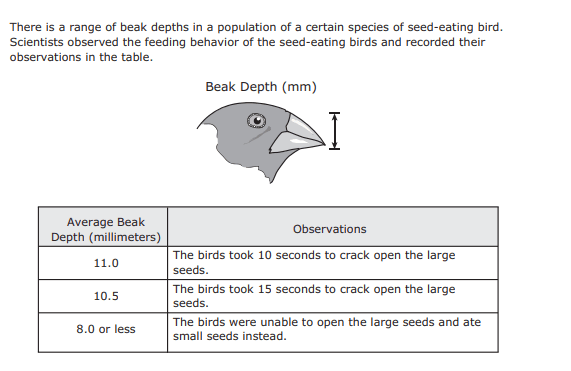
Neither birds with a small beak depth nor birds with a large beak depth will have are productive advantage.
Birds with a small beak depth will have an advantage over birds with large beak depths and will be better able to survive and reproduce.
Birds with a large beak depth will require less food in order to survive and reproduce
Birds with a large beak depth will have an advantage over birds with a small beak depth and will be better able to survive and reproduce.
300s - Q15
Based on the key, what is the name of this wildflower?
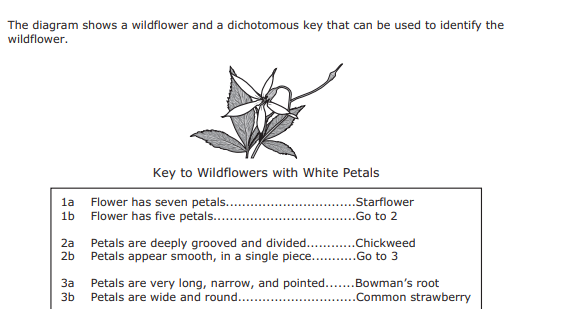
Starflower
Bowman’s root
Common strawberry
Chickweed
300s