demonstrate that Earth rotates on its axis once approximately every 24 hours causing the day/night cycle and the apparent movement of the Sun across the sky
Track each student's skills and progress in your Mastery dashboards
Give this quiz to my class
Q 1/12
Score 0
All of these are related to the formation of oil or natural gas EXCEPT —
30
sedimentary rocks
decomposed animals
active volcanoes
decayed plants
Q 2/12
Score 0
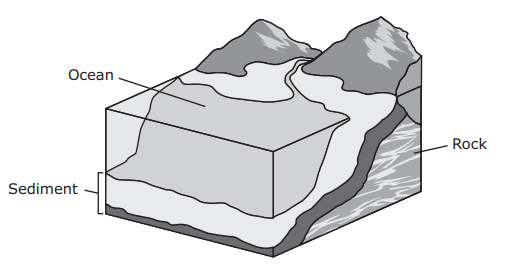
The model below shows layers of sediment on the floor of an ocean. Which of the following best explains how these layers can become rock over many years?
30
Pollution caused by humans turns the sediment into rock.
Sand in the sediment melts and turns into rock.
The weight of the water compacts the sediment into rock.
Changing water temperatures turn sand in the sediment into rock
12 questions
Q.
All of these are related to the formation of oil or natural gas EXCEPT —
1
30 sec
5.7.A: Earth and Space
Q.
The model below shows layers of sediment on the floor of an ocean. Which of the following best explains how these layers can become rock over many years?
2
30 sec
5.7.A: Earth and Space
Q.
Fossil fuels formed over long periods of time after particles in water settled to the sea floor and formed marine mud. What kinds of particles needed to be present in the marine mud in order for fossil fuels to form?
3
30 sec
5.7.A: Earth and Space
Q.
Erosion is one of the processes involved in the formation of sedimentary rock. Which of these best describes the process of erosion?
4
30 sec
5.7.A: Earth and Space
Q.
A student hiking in a rocky area on a mountain notices that wide, deep cracks have formed in some of the large rocks. Some of the cracks are so large that the rocks have broken apart. Which process most likely caused these rocks to crack and break?
5
30 sec
5.7.B: Earth and Space
Q.
Students constructed this model of a hill by covering sugar cubes with clay. The students placed the model in a large pan and poured hot water over it every day for a week. What does the model best represent?
6
30 sec
5.7.B: Earth and Space
Q.
The Rio Grande Valley is located at the southern tip of Texas at the end of a long river known as the Rio Grande. How did the delta at the end of the Rio Grande form?
7
30 sec
5.7.B: Earth and Space
Q.
Glaciers are masses of ice that move slowly on land. Which of these features was most likely formed by a glacier?
8
30 sec
5.7.B: Earth and Space
Q.
Shadows cast by objects change throughout the day. The picture below shows the shadow cast by a tree at 3:00 P.M. Which picture shows how the tree’s shadow most likely looked at 9:00 A.M.?
9
30 sec
5.8.C: Earth and Space
Q.
A student is looking for evidence that Earth is always rotating on its axis. Which of the following would provide the best evidence?
10
30 sec
5.8.C: Earth and Space
Q.
A student draws a model showing the movements of Earth, the moon, and the sun.
Which arrow shows the movement that causes day and night on Earth?
11
30 sec
5.8.C: Earth and Space
Q.
A student builds a model of the solar system that includes a sphere representing Earth. The sphere turns in a full circle on its axis. By using a model of Earth that spins on its axis, the student can best demonstrate —